
Cardiac Monitoring Devices Market Size to Reach USD 45.91 Billion by 2031
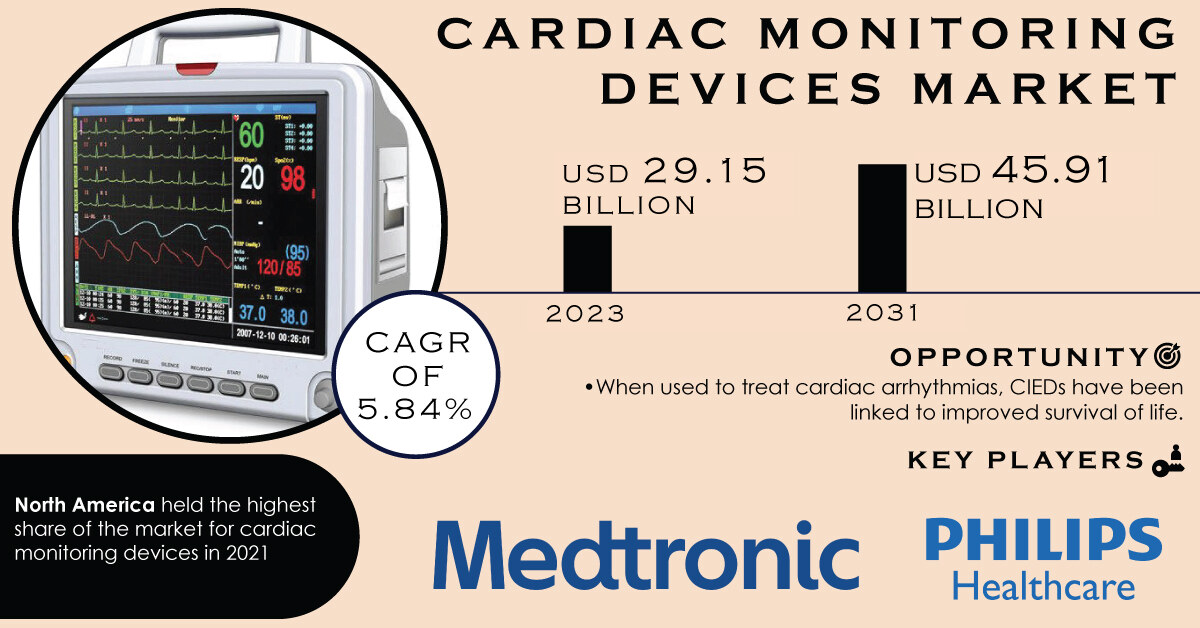
Cardiac Monitoring Devices Market
Cardiac Monitoring Devices Market Shows Exponential Growth, Driven by Rising Cardiovascular Disease Incidences and Technological Advancements
AUSTIN, TEXAS, UNITED STATES, May 21, 2024 /EINPresswire.com/ -- The global Cardiac Monitoring Devices Market Size, valued at USD 29.15 billion in 2023, is anticipated to experience significant growth, reaching USD 45.91 billion by 2031. This growth, at a compound annual growth rate (CAGR) of 5.84% over the forecast period from 2024 to 2031, is driven by the rising prevalence of cardiovascular diseases (CVDs), technological advancements in cardiac monitoring, and increasing awareness of heart health management.Cardiac monitoring devices are essential tools in the management of heart diseases. They include a range of products such as electrocardiogram (ECG) devices, implantable loop recorders, Holter monitors, event monitors, and cardiac telemetry devices. These devices are crucial for detecting arrhythmias, monitoring cardiac function, and guiding treatment decisions.
"The increasing prevalence of cardiovascular diseases and the rapid advancements in cardiac monitoring technologies are driving the market growth," said Dr. Michael Turner, Chief Cardiologist at HeartCare Institute. "These devices play a critical role in early diagnosis, continuous monitoring, and effective management of heart conditions."
Download Free Sample Report of Cardiac Monitoring Devices Market @ https://www.snsinsider.com/sample-request/1021
List of Cardiac Monitoring Devices Companies Profiled in Report:
• Abbott
• BioTelemetry (Formerly CardioNet)
• BIOTRONIK
• Boston Scientific
• Cardiac Science Corporation
• Edwards Life Sciences
• FUKUDA DENSHI
• GE Healthcare
• Hill-rom Services, Inc.
• iRhythm Technologies Inc,
• Lifewatch AG
• Medtronic
• Midmark Corp.
• Mortara Healthcare
• Nihon Kohden Corporation
• Philips Healthcare
• Schiller AG
• Shenzhen Mindray Bio-Medical Electronics Co., Ltd.
• SORIN GROUP
• Spacelabs Healthcare
• St. Jude Medical
• Zoll Medical
(To view Full list of companies, Ask for Sample Report)
Rising Prevalence of Cardiovascular Diseases
The global rise in cardiovascular diseases, including coronary artery disease, heart failure, and arrhythmias, is a significant driver of the cardiac monitoring devices market. According to the World Health Organization (WHO), CVDs are the leading cause of death globally, responsible for an estimated 17.9 million deaths each year. The increasing burden of heart diseases is leading to a higher demand for cardiac monitoring devices.
The aging population and the prevalence of risk factors such as hypertension, diabetes, obesity, and sedentary lifestyles are contributing to the rise in cardiovascular diseases. Early diagnosis and continuous monitoring are essential for managing these conditions and preventing complications, thereby driving the adoption of cardiac monitoring devices.
"The rising prevalence of cardiovascular diseases is a major factor driving the demand for cardiac monitoring devices," noted Dr. Turner. "Early detection and continuous monitoring are critical for effective management and improved patient outcomes."
Technological Advancements in Cardiac Monitoring
Technological advancements in cardiac monitoring devices are significantly enhancing their accuracy, functionality, and patient comfort. Innovations such as wireless and wearable devices, advanced algorithms for data analysis, and remote monitoring capabilities are transforming the field of cardiac care. These advancements allow for continuous, real-time monitoring of cardiac function, providing valuable data for timely interventions.
Wearable devices, such as smartwatches with ECG capabilities, are gaining popularity due to their convenience and ability to provide continuous monitoring without disrupting daily activities. Implantable devices, including loop recorders, offer long-term monitoring solutions for patients with chronic heart conditions. The integration of artificial intelligence (AI) and machine learning (ML) is also improving the diagnostic accuracy and predictive capabilities of cardiac monitoring systems.
"Technological advancements are revolutionizing cardiac monitoring, making devices more accurate, convenient, and user-friendly," stated Dr. Turner. "Innovations in wearable and implantable devices, coupled with AI-driven data analysis, are enhancing patient care and outcomes."
Increasing Awareness and Preventive Healthcare
Increasing awareness of heart health and the importance of preventive healthcare are contributing to market growth. Public health campaigns, educational initiatives, and the efforts of healthcare providers are raising awareness about the risk factors and symptoms of cardiovascular diseases. This heightened awareness is encouraging individuals to undergo regular cardiac check-ups and use monitoring devices to manage their heart health proactively.
Healthcare providers are also emphasizing the importance of preventive measures and early detection in managing heart diseases. The use of cardiac monitoring devices for routine check-ups and continuous monitoring is becoming a standard practice, leading to better disease management and improved patient outcomes.
"Increasing awareness of heart health and preventive healthcare measures are driving the adoption of cardiac monitoring devices," emphasized Dr. Turner. "Regular monitoring and early detection are key to managing heart diseases effectively."
Have Any Query? Ask Our Experts @ https://www.snsinsider.com/enquiry/1021
Regional Insights
North America currently dominates the cardiac monitoring devices market, driven by a high prevalence of cardiovascular diseases, advanced healthcare infrastructure, and significant investments in medical technology. The United States, in particular, is a major contributor to market growth, with numerous leading medical device companies and research institutions.
The Europe and Asia-Pacific regions are also expected to witness significant growth during the forecast period. Factors such as increasing healthcare expenditure, rising awareness of cardiovascular health, and the adoption of advanced cardiac monitoring technologies are driving market expansion in these regions. The Asia-Pacific region, in particular, is experiencing rapid growth due to the increasing burden of cardiovascular diseases and improving access to healthcare services.
"North America leads the market, but Europe and Asia-Pacific are emerging as significant growth areas," noted Dr. Turner. "Increased healthcare investments and technological adoption are driving market growth in these regions."
Market Challenges and Opportunities
Despite the promising outlook, the cardiac monitoring devices market faces challenges such as high device costs, reimbursement issues, and the need for continuous technological advancements. Addressing these challenges requires strategic investments in research and development, policy advocacy for favorable reimbursement frameworks, and efforts to make advanced monitoring devices more affordable and accessible.
However, these challenges also present opportunities for innovation and growth. Companies are investing in the development of cost-effective, user-friendly devices that cater to the diverse needs of patients and healthcare providers. Additionally, strategic collaborations and partnerships are essential for advancing research, expanding market reach, and improving patient care.
Key Takeaways:
- The global cardiac monitoring devices market is projected to grow from $29.15 billion in 2023 to $45.91 billion by 2031, at a CAGR of 5.84%.
- The rising prevalence of cardiovascular diseases and technological advancements in cardiac monitoring are driving market growth.
- Increasing awareness of heart health and preventive healthcare measures are contributing to market expansion.
- North America currently leads the market, with significant growth expected in Europe and Asia-Pacific regions.
- Challenges such as high device costs and reimbursement issues present opportunities for innovation and collaboration.
As the cardiac monitoring devices market continues to evolve, driven by the increasing prevalence of cardiovascular diseases, technological advancements, and growing awareness of heart health, it holds significant potential for improving patient care and outcomes. Industry stakeholders are well-positioned to capitalize on these trends, delivering innovative and effective monitoring solutions that meet the evolving needs of patients and healthcare providers alike.
Check Discount on This Report @ https://www.snsinsider.com/discount/1021
Table of Content
Chapter 1 Introduction
Chapter 2 Research Methodology
Chapter 3 Cardiac Monitoring Devices Market Dynamics
Chapter 4 Impact Analysis (COVID-19, Ukraine- Russia war, Ongoing Recession on Major Economies)
Chapter 5 Value Chain Analysis
Chapter 6 Porter’s 5 forces model
Chapter 7 PEST Analysis
Chapter 8 Cardiac Monitoring Devices Market Segmentation, By Type
Chapter 9 Cardiac Monitoring Devices Market Segmentation, By Product
Chapter 10 Regional Analysis
Chapter 11 Company profile
Chapter 12 Competitive Landscape
Chapter 13 Use Case and Best Practices
Chapter 14 Conclusion
Continued…
Akash Anand
SNS Insider Pvt. Ltd
+1 415-230-0044
email us here
Visit us on social media:
Facebook
Twitter
LinkedIn
Instagram
YouTube
Legal Disclaimer:
EIN Presswire provides this news content "as is" without warranty of any kind. We do not accept any responsibility or liability for the accuracy, content, images, videos, licenses, completeness, legality, or reliability of the information contained in this article. If you have any complaints or copyright issues related to this article, kindly contact the author above.
