
Geographic Atrophy (GA) Market Size, Share and Significant Growth at a CAGR of 7.2% from 2023 to 2030
Geographic Atrophy Market
Geographic Atrophy (GA) Market Shows Exponential Growth, Driven by Rising Prevalence of Age-Related Macular Degeneration and Advancements in Treatment
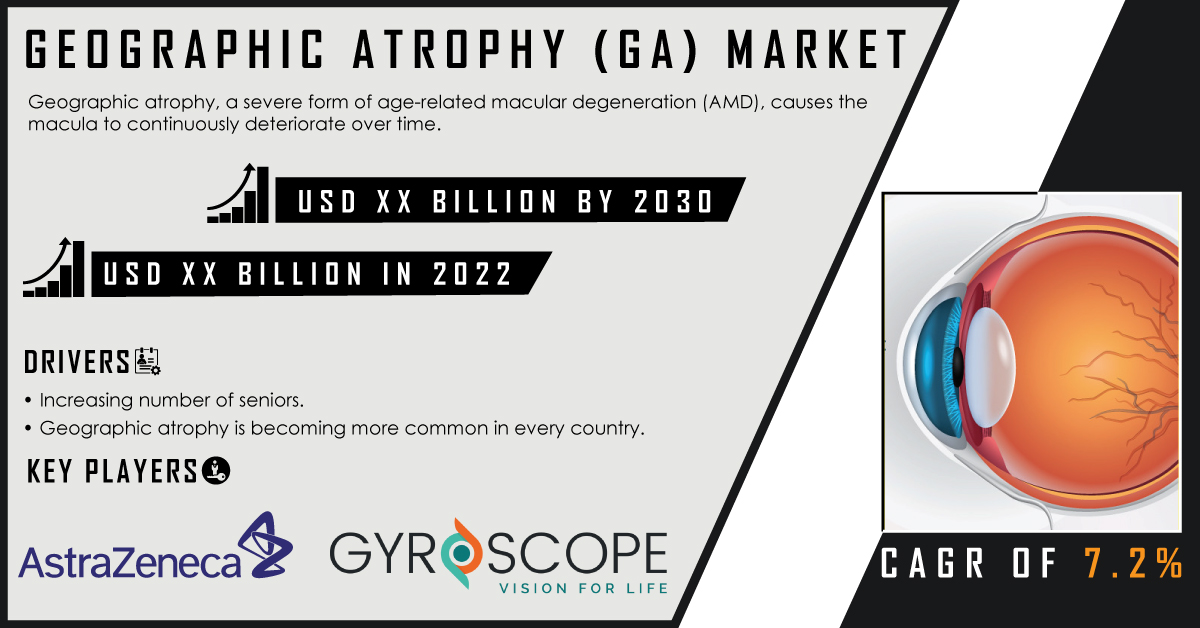
AUSTIN, TEXAS, UNITED STATES, May 21, 2024 /EINPresswire.com/ -- The global Geographic Atrophy (GA) Market, a progressive form of age-related macular degeneration (AMD), is projected to experience substantial growth, with a compound annual growth rate (CAGR) of 7.2% over the forecast period from 2023 to 2030. This market expansion is driven by the rising prevalence of GA, advancements in treatment options, and increasing awareness of the disease.Geographic atrophy is an advanced and severe form of AMD that leads to the gradual loss of vision due to the degeneration of the retinal pigment epithelium (RPE) and photoreceptors. It predominantly affects the elderly population, significantly impacting their quality of life and independence. The GA market encompasses a range of diagnostics and therapeutic solutions aimed at managing and mitigating the progression of the disease.
"With an aging global population and the increasing incidence of AMD, the geographic atrophy market is set to expand significantly," said Dr. Laura Smith, Head of Ophthalmology Research at Vision Health Institute. "Innovative therapies and diagnostic advancements are providing hope for improved management of this debilitating condition."
Download Free Sample Report of Geographic Atrophy (GA) Market @ https://www.snsinsider.com/sample-request/2480
List of Geographic Atrophy (GA) Companies Profiled in Report:
• Alkeus Pharmaceuticals, Inc.
• Allegro Ophthalmics, LLC
• Apellis Pharmaceuticals, Inc.
• AstraZeneca plc
• F. Hoffmann-La Roche AG
• Genentech Inc.
• Gensight Biologics SA
• Gyroscope Therapeutics Limited
• Hemera Biosciences LLC
• Hoffmann-La Roche AG
• Iveric Bio
• NGM Biopharmaceuticals Inc.
• Regenerative Patch Technologies LLC
• Stealth BioTherapeutics
(To view Full list of companies, Ask for Sample Report)
Rising Prevalence of Age-Related Macular Degeneration
The rising prevalence of AMD, particularly in developed countries, is a primary driver of the geographic atrophy market. As populations age, the incidence of AMD, and consequently GA, is expected to increase. According to the World Health Organization (WHO), AMD is one of the leading causes of blindness in individuals over the age of 60, with millions affected worldwide.
The increasing prevalence of GA highlights the urgent need for effective treatments and management strategies. Healthcare systems and providers are increasingly focusing on early detection and intervention to slow the progression of GA and preserve vision.
"The rising prevalence of AMD and GA is driving demand for effective diagnostic and therapeutic solutions," noted Dr. Smith. "Early detection and intervention are crucial in managing the disease and improving patient outcomes."
Advancements in Treatment Options
Significant advancements in treatment options for GA are contributing to market growth. Currently, there are no approved treatments specifically for GA, but ongoing research and development efforts are promising. Innovative therapies, including gene therapy, stem cell therapy, and complement inhibition, are under investigation and show potential for altering the course of the disease.
Several pharmaceutical companies are in the advanced stages of clinical trials for GA treatments. These potential therapies aim to slow the progression of the disease, preserve vision, and improve the quality of life for patients. The introduction of these therapies to the market could transform the treatment landscape for GA.
"Advancements in treatment options for GA are promising and have the potential to change the disease management paradigm," stated Dr. Smith. "Innovative therapies are being developed to address the unmet needs of GA patients."
Increasing Awareness and Early Diagnosis
Increasing awareness of GA and the importance of early diagnosis are driving market growth. Public health campaigns, educational initiatives, and advocacy by professional organizations are raising awareness about the symptoms and risks of AMD and GA. This heightened awareness is encouraging individuals to seek regular eye examinations, leading to earlier diagnosis and intervention.
Healthcare providers are also becoming more attuned to the importance of early detection and management of GA. The use of advanced diagnostic tools, such as optical coherence tomography (OCT) and fundus autofluorescence (FAF), is improving the accuracy and timeliness of GA diagnosis. These tools enable ophthalmologists to detect early signs of GA and monitor disease progression more effectively.
"Increasing awareness and early diagnosis are crucial in managing GA effectively," emphasized Dr. Smith. "Advanced diagnostic tools are enhancing our ability to detect and monitor the disease, leading to better patient outcomes."
Have Any Query? Ask Our Experts @ https://www.snsinsider.com/enquiry/2480
Regional Insights
North America currently dominates the GA market, driven by a high prevalence of AMD, robust healthcare infrastructure, and significant investments in research and development. The United States, in particular, is a major contributor to market growth, with numerous leading academic institutions and pharmaceutical companies actively involved in GA research.
The Europe and Asia-Pacific regions are also expected to witness significant growth during the forecast period. Factors such as increasing healthcare expenditure, rising awareness of AMD and GA, and the adoption of advanced diagnostic and therapeutic technologies are driving market expansion in these regions. The Asia-Pacific region, in particular, is experiencing rapid growth due to the increasing elderly population and improving access to healthcare services.
"North America leads the market, but Europe and Asia-Pacific are emerging as significant growth areas," noted Dr. Smith. "Increased healthcare investments and technological adoption are driving market growth in these regions."
Market Challenges and Opportunities
Despite the promising outlook, the GA market faces challenges such as the high cost of advanced treatments, limited access to healthcare in some regions, and the need for continued research and development. Addressing these challenges requires strategic investments in healthcare infrastructure, patient education, and support for ongoing research efforts.
However, these challenges also present opportunities for innovation and growth. Companies are investing in the development of cost-effective therapies and diagnostic tools to expand access to GA management. Additionally, partnerships with academic institutions and healthcare providers are essential for advancing research and improving patient care.
Key Takeaways:
• The global geographic atrophy (GA) market is projected to grow at a CAGR of 7.2% from 2023 to 2030.
• The rising prevalence of age-related macular degeneration (AMD) is a primary driver of market growth.
• Significant advancements in treatment options and increasing awareness of GA are contributing to market expansion.
• North America currently leads the market, with significant growth expected in Europe and Asia-Pacific regions.
• Challenges such as high treatment costs and limited healthcare access present opportunities for innovation and collaboration.
As the GA market continues to evolve, driven by the increasing prevalence of AMD, advancements in treatment options, and growing awareness of the disease, it holds significant potential for improving the lives of individuals affected by GA. Industry stakeholders are well-positioned to capitalize on these trends, delivering innovative and effective solutions that meet the evolving needs of patients and healthcare providers alike.
Check Discount on This Report @ https://www.snsinsider.com/discount/2480
Table of Content
Chapter 1 Introduction
Chapter 2 Research Methodology
Chapter 3 Geographic Atrophy (GA) Market Dynamics
Chapter 4 Impact Analysis (COVID-19, Ukraine- Russia war, Ongoing Recession on Major Economies)
Chapter 5 Value Chain Analysis
Chapter 6 Porter’s 5 forces model
Chapter 7 PEST Analysis
Chapter 8 Geographic Atrophy (GA) Market Segmentation, By Age Group
Chapter 9 Geographic Atrophy (GA) Market Segmentation, By Diagnosis
Chapter 10 Geographic Atrophy (GA) Market Segmentation, By Therapeutic Agents Clinical Phase
Chapter 11 Regional Analysis
Chapter 12 Company profile
Chapter 13 Competitive Landscape
Chapter 14 Use Case and Best Practices
Chapter 15 Conclusion
Continued…
Akash Anand
SNS Insider Pvt. Ltd
+1 415-230-0044
email us here
Visit us on social media:
Facebook
Twitter
LinkedIn
Instagram
YouTube
Legal Disclaimer:
EIN Presswire provides this news content "as is" without warranty of any kind. We do not accept any responsibility or liability for the accuracy, content, images, videos, licenses, completeness, legality, or reliability of the information contained in this article. If you have any complaints or copyright issues related to this article, kindly contact the author above.
