
Photonic feature extractor for broadband radio-frequency signals
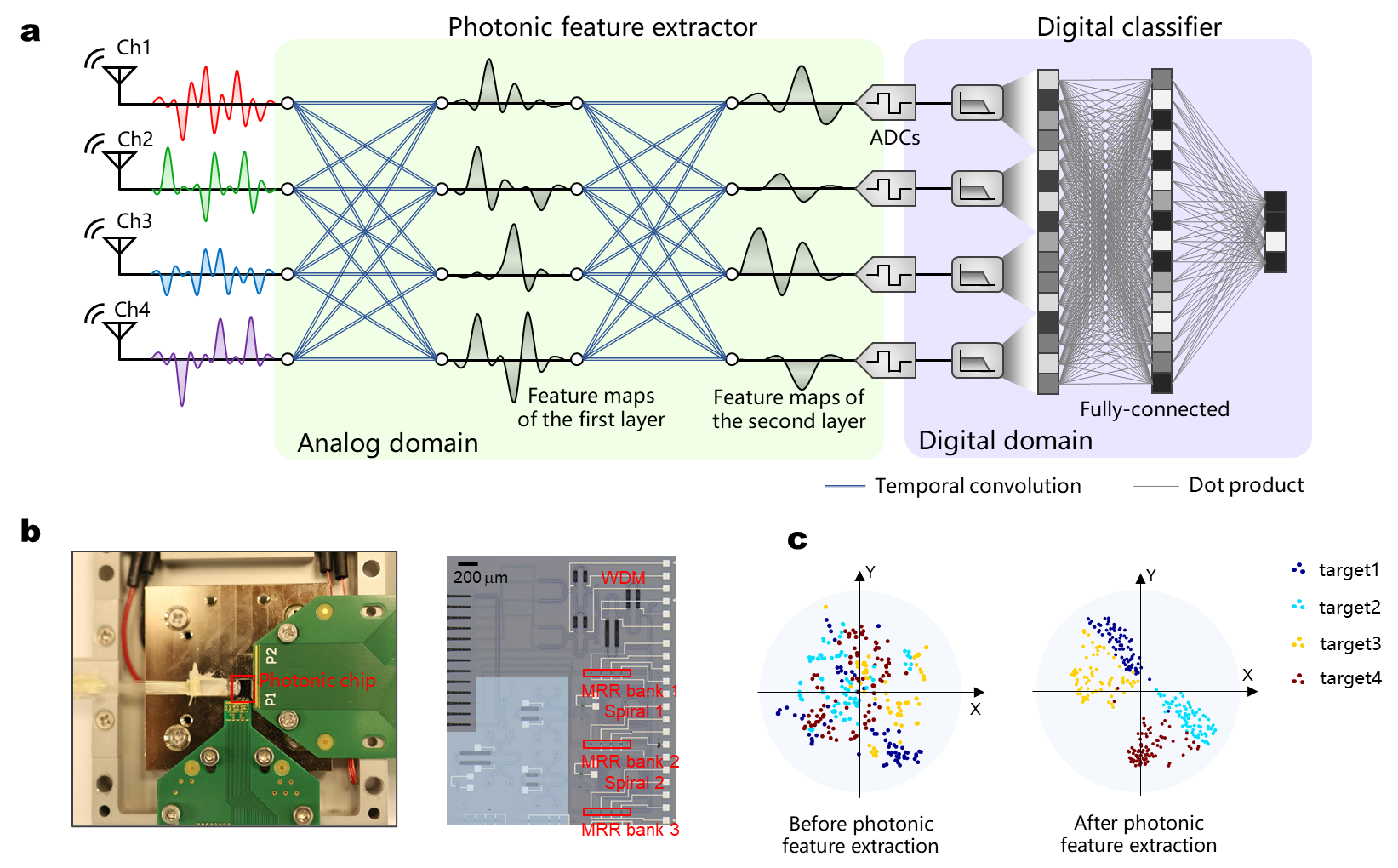
Working principle and results of the photonic feature extractor.
USA, April 1, 2024 /EINPresswire.com/ -- Cognitive radio-frequency (RF) sensing is essential in modern sensing applications, but efficiently processing the broadband RF signals is challenging. To tackle this problem, scientists in China invented a photonic chip, which transforms the broadband RF signals into sparse features and lessens the challenge of digital processing. The scheme offers a promising path for the efficient signal processing involved in autonomous driving, robotics, and smart factories.
In intelligent sensing fields such as radar, machine vision, medical imaging, etc., the critical information used for decision making is often sparse. For example, a monosyllabic waveform requires thousands of sampling points, but contains only a few bits of information. If the key information can be extracted directly in the analog link of signal reception, the redundancy of data can be drastically reduced as well as the data rate. The challenge of digital processing can be significantly lessened. Therefore, the so-called “analog feature extraction (AFE)” strategy have received extensive attention in the field of intelligent sensing. However, in the field of RF sensing, broadband signals of several GHz are usually required to discriminate target details. Under the bandwidth and reconfigurability bottlenecks of the existing RF circuits, the application of AFE strategy in the field of RF sensing faces challenges.
In a new paper (https://doi.org/10.1038/s41377-024-01390-9) published in Light Science & Applications, a team of scientists, led by Professor Weiwen Zou from State Key Laboratory of Advanced Optical Communication Systems and Networks, Intelligent Microwave Lightwave Integration Innovation Center (imLic), Department of Electronic Engineering, Shanghai Jiao Tong University, and co-workers have developed a photonic scheme to accomplish AFE of broadband RF signals. In principle, photonics is considered a competitive candidate for RF signal processing due to its broadband capability and reconfigurability. If the physical structure of feature extraction in implemented in the photonic circuits, the input signals can be directly transformed into features without digital processing. Based on this idea, they implemented a photonic chip that can output key features directly from the original RF signals received by the antenna. With these features, different targets are recognized with high accuracy. The reported scheme will provide a promising path for the efficient signal processing involved in autonomous driving, robotics, and smart factories.
The key part of their scheme is the photonic chip. The scientists summarize the working principle of their photonic chip: “The feature extraction structure is essentially a convolutional neural network that outputs the spatiotemporal feature of the input signals. The photonic chip imitates the neural network to conduct feature extraction for the RF signals. Additionally, we designed an efficient training method especially for the photonic feature extraction system. It drastically decreases the cost of neural network training and makes the training possible.”
“The experimental results indicates that the photonic feature extractor compresses the data rate 4 times while maintains a good target recognition accuracy of 97.5%. We analyzed the results and found that the photonic spatiotemporal feature extractor achieves 7.7% better recognition accuracy than that without feature extraction. Compared with one-dimensional feature extraction, the spatiotemporal feature extraction performs 6% better. So, we testified the effectiveness of the photonic feature extractor.” They added, “We believe that our proposal will catalyze the development of naturally-efficient AFE strategies for broadband RF signal processing, and provide a promising path for the next-generation cognitive RF sensing systems.”
DOI
10.1038/s41377-024-01390-9
Original Source URL
https://doi.org/10.1038/s41377-024-01390-9
Funding information
This work is supported in part by the National Natural Science Foundation of China under Grant No. T2225023 and 62205203.
Lucy Wang
BioDesign Research
email us here
Legal Disclaimer:
EIN Presswire provides this news content "as is" without warranty of any kind. We do not accept any responsibility or liability for the accuracy, content, images, videos, licenses, completeness, legality, or reliability of the information contained in this article. If you have any complaints or copyright issues related to this article, kindly contact the author above.
