
Laser Manufacturing of Spatial Resolution Approaching Quantum Limit
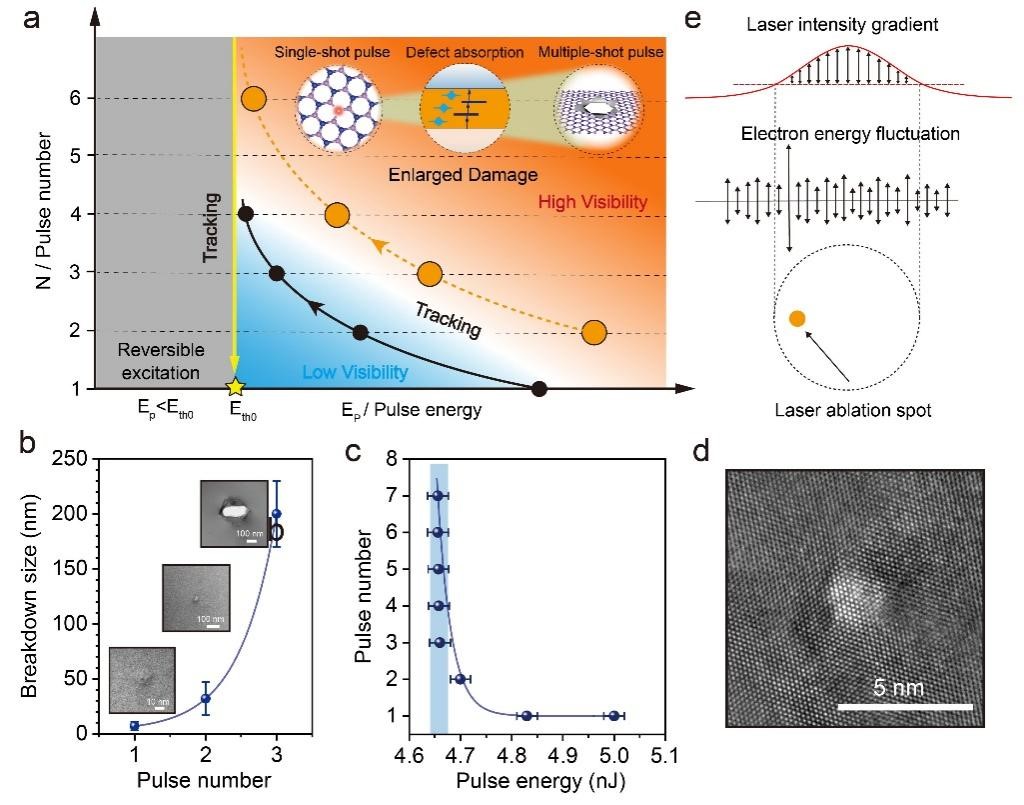
Schematic of the threshold tracking and lock-in technology.
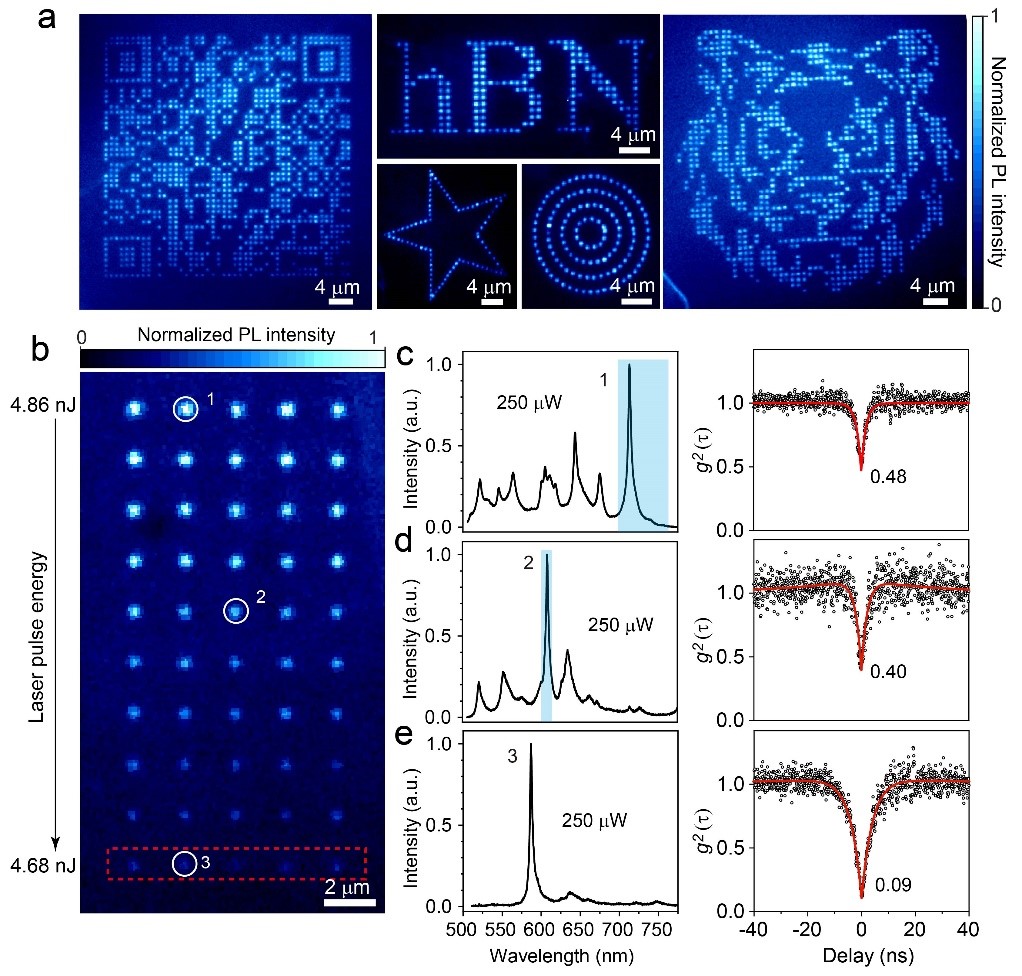
Deterministic creation of single-photon colour centres.
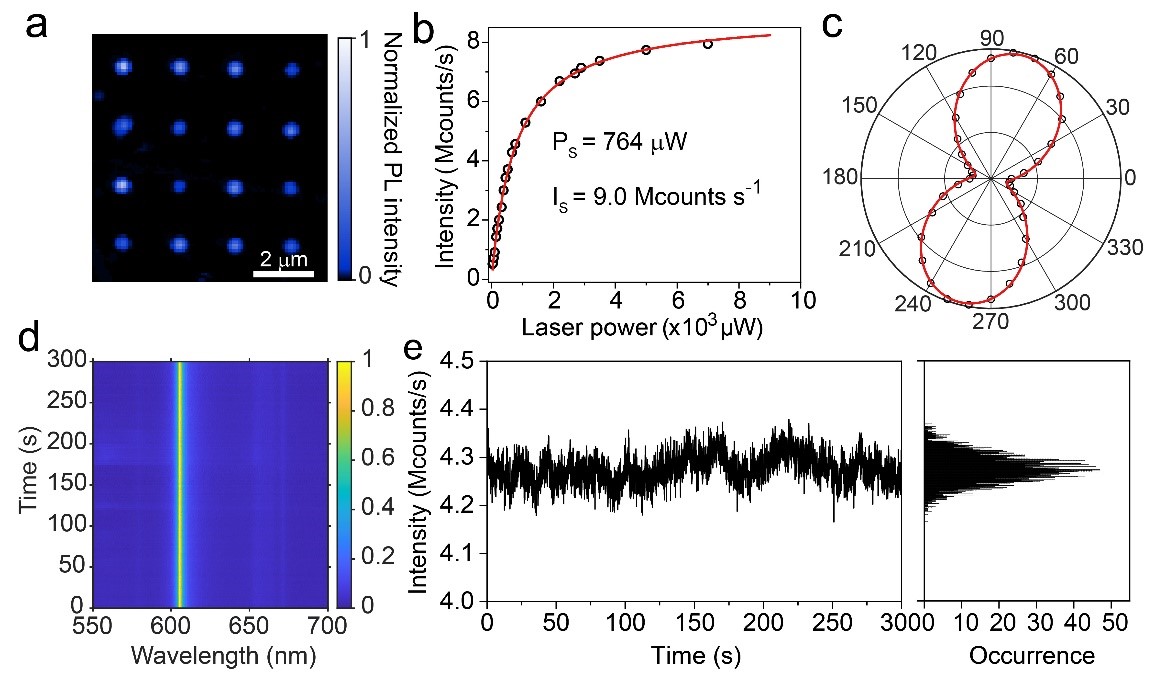
High reproducibility, high brightness, and high durability of single-photon single colour centres.
USA, February 8, 2024 /EINPresswire.com/ -- Since the advent of femtosecond laser in the early 1990s, ultrafast laser processing has been considered a promising nanofabrication approach, which is unique in manufacturing hard-processing materials and realizing fine three-dimensional structures. The first barrier toward high fabrication resolution, the so-called optical diffraction limit, has been striding over. Now, a new question has arisen, how precise could the technology provide and what is its resolution limit? Toward this goal, scientists in China report a spatial resolution improved to the quantum limit by exploiting a threshold tracing and lock-in (TTL) method, and a feature size of less than 5 nm is realized. In this way, single quantum emitters are deterministically created with a unity yield and high positional accuracy, serving as a step forward for integrated quantum technological applications.
Since early demonstrations of femtosecond laser as a three-dimensional (3D) processing tool, microdevices with exciting optical, electronic, mechanical, and magnetic functions have been manufactured, by which novel concepts from 3D quantum photonic integrated circuits to intelligent micro-robots are enabled. Much effort in the past decade in this field has been devoted to improving manufacture spatial resolution, and several tens of nanometre feature sizes have been reported based on multiphoton absorption, stimulation emission depletion, far-field-induced near-field enhancement, and photoexcitation-induced chemical bonding effects. Nevertheless, advanced applications, such as single-electron transistors, single-photon emitters (SPE), single-atom memory, or quantum-bit devices, require higher manufacturing spatial resolution (less than 10 nm, far beyond the optical diffraction limit).
In a new paper (doi: 10.1038/s41377-023-01354-5) published in Light Science & Application, a team of scientists, led by Professor Hongbo Sun from State Key Laboratory of Precision Measurement Technology and Instruments, Department of Precision Instrument, Tsinghua University, Beijing, China, and co-workers have proposed and experimentally demonstrated close-to-atom scale manufacturing using a threshold tracking and lock-in (TTL) method, by which feature sizes of < 5 nm, ~ λ/100, approaching quantum limit, are realised. By this way, researchers could achieve near unity yield fabrication of single photon sources with high positional accuracy and minimal damage to the lattice. These single photon sources exhibit high brightness, high emission purity, and high stability. This close-to-atom scale laser manufacturing represents a significant step forward in scalable quantum photonic technologies. These scientists summarize the principle of TTL technology:
“The idea is to use the additional laser pulses (probe light) to precisely track whether atomic or close-atomic scale damage occurs under the initial pulse (fabricating light). The intrinsic damage threshold of the target material is precisely locked. It is worth mentioning that this feedback method does not depend on the detection sensitivity of the instrument, and can accurately lock the intrinsic damage threshold of the target material for nanoscale laser manufacturing.”
“We demonstrated that the laser manufacturing accuracy in this work has reached the quantum limit, which is a new milestone after the optical diffraction limit. When the laser energy approaches the near-atomic scale damage threshold, the laser ablation of individual atoms does not necessarily occur in the geometric center of the focused spot. This is because, in this limit state, the gradient provided by the laser energy (the top of the Gaussian distribution) will be very flat. The breakdown region defined by the laser energy gradient will fail, and local atomic ablation will randomly occur in a certain region (~ a few nanometers, the specific value is related to the target material), which will be dominated by the position and energy fluctuations of local electrons, rather than the power density slope of the incident laser.”
“By TTL technology, the near unity yield manufacturing of single photon sources with nanoscale positioning precision could be realized. Meanwhile, these single photon sources exhibit excellent properties including high brightness (emitting nearly ten million photons per second), high emission purity, and high stability. This result suggests the high potential of close-to-atom scale laser manufacturing for the application of quantum devices.”
DOI
10.1038/s41377-023-01354-5
Original Source URL
https://doi.org/10.1038/s41377-023-01354-5
Funding information
The work was supported by the National Natural Science Foundation of China (NSFC) under Grants nos. 62075115, 61960206003, and 61590930.
Lucy Wang
BioDesign Research
email us here
Legal Disclaimer:
EIN Presswire provides this news content "as is" without warranty of any kind. We do not accept any responsibility or liability for the accuracy, content, images, videos, licenses, completeness, legality, or reliability of the information contained in this article. If you have any complaints or copyright issues related to this article, kindly contact the author above.
