
Cleaner Nuclear Energy: A Breakthrough in Iodine Capture
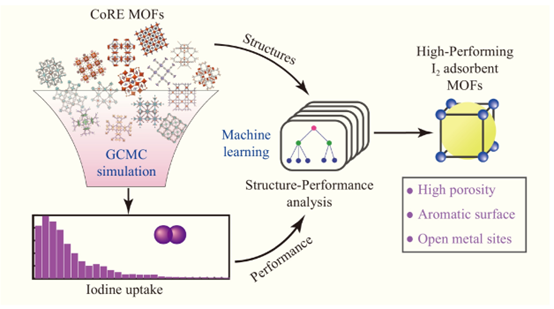
Graphic abstract.
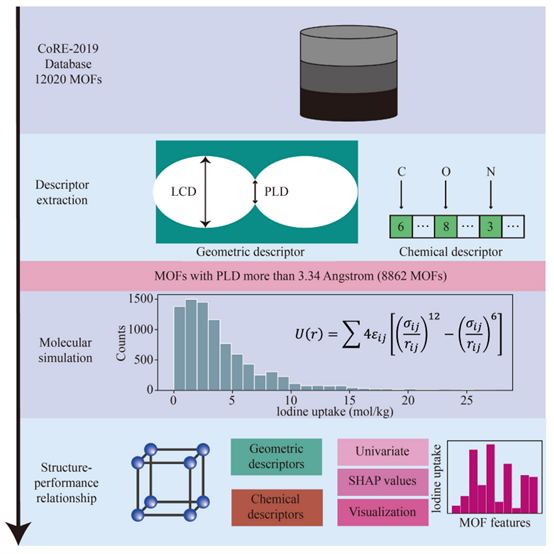
Illustration of the proposed large-scale virtual screening strategy of MOFs for high performing iodine adsorbents.
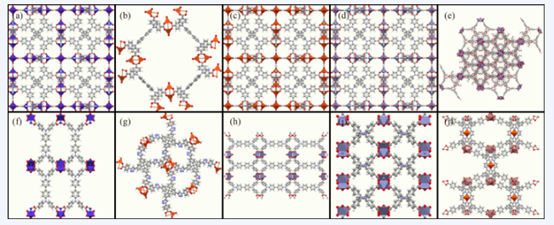
Overview of the crystal structures of Top 10 MOFs identified with the highest predicted I2 uptake (a–e: Nos. 1–5; f–j: Nos. 6–10).
CHINA, November 29, 2023 /EINPresswire.com/ -- Nuclear energy is a key player in the global high-grade energy landscape, offering reliable electricity with minimal environmental impact. However, managing and processing spent nuclear fuel (SNF) is crucial for sustainable and safe nuclear power deployment. A significant challenge in this process is the containment of radioactive iodine isotopes, like ¹²⁹I and ¹³¹I, which pose long-term environmental risks and acute health hazards. Therefore, the capture and sequestration of radioactive iodine are critical in the nuclear industry.
In a new study published on 15 July 2023, in the journal Frontiers of Environmental Science & Engineering, researchers from Sichuan University have unveiled significant insights into the structure-performance relationships of metal-organic frameworks (MOFs). Their study not only sheds light on the complexities involved in the iodine uptake capabilities of MOFs but also emphasizes the necessity for a comprehensive, multifaceted analysis.
In this comprehensive study, researchers employed large-scale molecular simulation and machine learning (ML) to identify the most effective MOFs for capturing gaseous iodine. Utilizing a grand canonical Monte Carlo simulation across a database of 8,862 MOFs, the team was able to predict iodine uptake values and pinpoint the top 10 MOFs, visualizing their specific adsorption sites. Further employing ML, they established vital structure-property relationships, linking MOFs' structural and chemical features to their iodine capture efficiency. This study not only revealed key insights into the MOFs' structure-performance relationships, demonstrating a strong correlation between certain geometric features like large cavity size and surface area and enhanced iodine uptake, but also highlighted the necessity of multifactorial analysis. This approach was crucial in understanding that no single feature could solely predict a MOF's iodine uptake capability, marking a significant advancement in the field of environmental material design.
Highlights
● Screened 8862 metal-organic frameworks for I2 capture via molecular simulation.
● Ranked metal-organic frameworks on predicted I 2 uptake and identified Top 10.
● Established quantitative structure-property relationships via machine learning.
This research establishes a comprehensive framework for creating advanced MOF adsorbents, enhancing the capture and recovery of radioactive iodine and similar volatile environmental hazards. It presents a significant stride in improving nuclear fuel reprocessing and management, substantially contributing to radiochemistry and the pursuit of sustainable nuclear energy.
DOI
10.1007/s11783-023-1748-3
Original Source URL
https://doi.org/10.1007/s11783-023-1748-3
Funding information
The National Natural Science Foundation of China (22176135).
The Fundamental Research Funds for the Central Universities in China (YJ201976).
Start-up funds from the School of Chemical Engineering, Sichuan University (C.L.).
Lucy Wang
BioDesign Research
email us here
Legal Disclaimer:
EIN Presswire provides this news content "as is" without warranty of any kind. We do not accept any responsibility or liability for the accuracy, content, images, videos, licenses, completeness, legality, or reliability of the information contained in this article. If you have any complaints or copyright issues related to this article, kindly contact the author above.
