
Off-Grid Solar Market Trends & Research Insights by 2031
OFF Grid Solar
Off-Grid Solar Market is estimated to exceed USD 5.8 billion by 2031
OREGON, PORTLAND, UNITED STATES, June 29, 2023/EINPresswire.com/ --
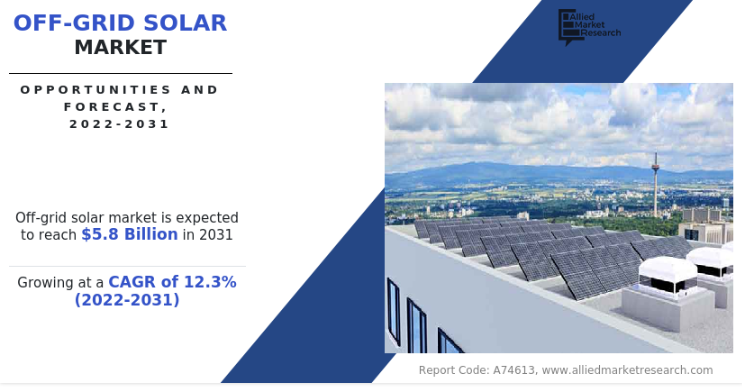
The off-grid solar market size was valued at $1.9 billion in 2021, and is estimated to reach $5.8 billion by 2031, growing at a CAGR of 12.3% from 2022 to 2031.
Off-grid solar refers to a solar power system that operates independently of the electrical grid. It typically includes solar panels, a charge controller, a battery bank, and an inverter. Off-grid solar systems are commonly used in remote locations were connecting to the grid is not feasible or economical.
Get a PDF brochure for Industrial Insights and Business Intelligence: https://www.alliedmarketresearch.com/request-sample/75097
Off-grid solar systems allow individuals or communities to generate their own electricity without relying on the electrical grid.
Off-grid solar systems generate clean, renewable energy, reducing reliance on fossil fuels and minimizing greenhouse gas emissions.
The key players profiled in the off-grid solar market analysis report include ABB Ltd., Schneider Electric SE, Canadian Solar, Engie, SMA Solar Technology ag, Jinko Solar Holding Co. Ltd, SunPower Corporation, Delta Electronics, Greenlight Plant, and Hanwha Group.
The solar panels, often mounted on rooftops or ground-mounted structures, capture sunlight and convert it into direct current (DC) electricity. Solar panels are made up of multiple photovoltaic (PV) cells that generate electricity when exposed to sunlight.
The off-grid solar system prices have decreased significantly over time because of technology advancements and economies of scale. These systems provide a more affordable option than building out network infrastructure in remote locations, which may be quite expensive.
Off-grid solar power makes decentralised electricity generation more economical since it does not require significant transmission and distribution networks.
Off-grid solar system prices have decreased significantly due to developments in power electronics, batteries, and solar panel technology.
Better energy storage and power management for off-grid systems are now possible due to advancements in battery technology in terms of cost, durability, and storage capacity.
Cost-effective power electronics like inverters have improved, allowing for a greater conversion of solar energy into useful electricity.
Buy This Report (260 Pages PDF with Insights, Charts, Tables, and Figures): https://bit.ly/3CSV74Q
Off-grid solar systems are becoming more affordable owing to technology advancements and economies of scale, which make them a viable option for decentralised energy production.
Off-grid solar systems usually use batteries to save energy for use when sunlight is no longer available, such as at night or during cloudy weather.
Modern battery technologies have certain limitations that can affect the availability of electricity in off-grid solar systems. These barriers in energy storage capability and lifespan can result in conditions where off-grid solar structures cannot provide sufficient electrical energy during extended periods of inclement weather, such as during prolonged durations of rain or heavy cloud cover.
High strength demand for the duration of certain times may exceed the capacity of the batteries, leading to limitations in accessing electricity.
The off-grid solar allows for decentralized energy generation, reducing dependence on centralized power plants and transmission lines. This decentralized approach enhances energy resilience and reduces the risk of power outages, especially in areas prone to natural disasters or with unreliable grid infrastructure.
Impact of COVID-19
COVID-19 impacted almost all industries as lockdown measures and social distancing guidelines made it difficult for off-grid solar companies to conduct installations, repairs, and maintenance. This posed challenges in deploying new systems or providing timely support and services to existing customers.
Enquiry Before Buying: https://www.alliedmarketresearch.com/purchase-enquiry/75097
The off-grid solar industry heavily relies on global supply chains for components such as solar panels, batteries, and inverters. The pandemic disrupted these supply chains, causing delays and shortages, which affected the availability and affordability of off-grid solar systems. The economic impact of the pandemic led to financial constraints for individuals and businesses, affecting their ability to invest in off-grid solar systems.
Similar Reports:-
Solar Hydrogen Panel Market by Technology (Amorphous Silicon Solar Cells, Nano Solar Cells, Others), by End-Use (Residential, Industrial, Mobility, Others): Global Opportunity Analysis and Industry Forecast, 2023-2032
Solar Windows Market by Cell Type (Thin Film Photovoltaics (TPVs), Polymer Solar Cell, Others), by Transparency Type (Partial, Full), by Application (Residential, Commercial, Automotive, Others): Global Opportunity Analysis and Industry Forecast, 2023-2032
David Correa
Allied Analytics LLP
+ 1-800-792-5285
email us here
Legal Disclaimer:
EIN Presswire provides this news content "as is" without warranty of any kind. We do not accept any responsibility or liability for the accuracy, content, images, videos, licenses, completeness, legality, or reliability of the information contained in this article. If you have any complaints or copyright issues related to this article, kindly contact the author above.
