
China-Taiwan Weekly Update, May 12, 2023
AFGHANISTAN, May 12 - China-Taiwan Weekly Update, May 12, 2023
Authors: Nils Peterson and Roy Eakin of the Institute for the Study of War
Editors: Dan Blumenthal and Frederick W. Kagan of the American Enterprise Institute
Data Cutoff: May 11 at 4:30pm
The China–Taiwan Weekly Update focuses on Chinese Communist Party paths to controlling Taiwan and relevant cross–Taiwan Strait developments.
Key Takeaways
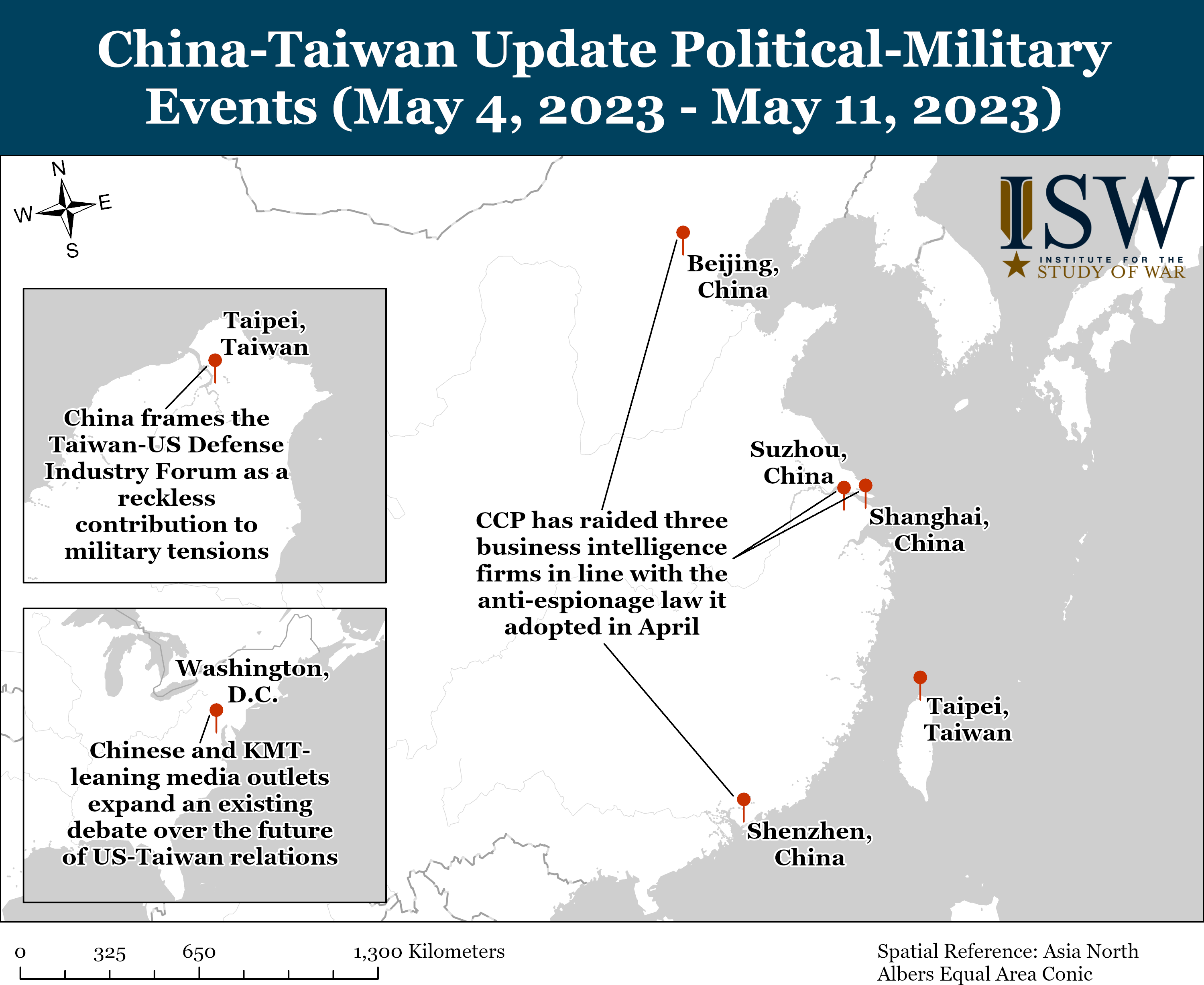
- The CCP has raided three business intelligence firms in line with the anti-espionage law it adopted in April, which will likely advance the CCP’s goal of technological and manufacturing self-reliance.
- Chinese and KMT-leaning media outlets expanded an existing debate over the future of US-Taiwan relations amid the 2024 Taiwanese presidential election, which could lead to the election of a candidate that is less supportive of US-Taiwan relations than the current administration.
- China framed the Taiwan-US Defense Industry Forum as a reckless contribution to military tensions, likely to promote Taiwanese skepticism towards US-Taiwan security cooperation.
China Developments
This section covers relevant developments pertaining to China and the governing Chinese Communist Party (CCP).
CCP Leadership Activity
Chinese Foreign Minister Qin Gang met with French and German officials from May 8-12, likely undermining EU efforts to sanction Chinese firms that are supporting the Russian war effort in Ukraine. Qin emphasized the intertwined Sino-French and Sino-German economic relationships when advocating against reducing trade linkages.[1] His visits correspond with EU discussion about proposed sanctions on seven Chinese firms reportedly selling equipment to Russia.[2] Two of the companies, 3HC Semiconductors and King-Pai Technology, already are under US sanctions. Germany reportedly opposed the initial sanctions proposal.[3] Only one EU state needs to oppose the sanctions to prevent their passage by the bloc.
Other
The CCP has raided three business intelligence firms in line with the anti-espionage law it adopted in April, which will likely advance the CCP’s goal of technological and manufacturing self-reliance. Chinese state security raided Mintz Group and Bain & Company over the past two months before raiding Capvision Partners this May for failing to “fulfill their anti-espionage and security obligations.”[4] The Capvision raid demonstrates that the CCP will use the broad definition of foreign agent in the anti-espionage law to control the information that companies operating in China allow foreign employees or clients to access.[5] This will place companies with foreign links at a competitive disadvantage compared to domestic companies when investing or operating in China. Increasing the domestic success of Chinese companies is in line with Xi’s core goals of achieving technological and manufacturing self-reliance that he re-stated in February and March.[6] However, he will continue to face the tension between achieving a heightened level of national security via self-reliant industries and growing the economy while disincentivizing foreign investment.
Taiwan Developments
This section covers relevant developments pertaining to Taiwan, including its upcoming January 13, 2024 presidential and legislative elections.
Elections
The Taiwanese (Republic of China) political spectrum is largely divided between the Democratic Progressive Party (DPP) and the Kuomintang (KMT). The DPP broadly favors Taiwanese autonomy, Taiwanese identity, and skepticism towards China. The KMT favors closer economic and cultural relations with China along with a broader alignment with a Chinese identity. The DPP under President Tsai Ing-wen has controlled the presidency and legislature (Legislative Yuan) since 2016. This presidential election cycle also includes the Taiwan People’s Party candidate Ko Wen-je who frames his movement as an amorphous alternative to the DPP and KMT. It is normal for Taiwanese presidential elections to have third party candidates, but none have ever won. The 2024 Taiwan presidential and legislative elections will be held on January 13, 2024 and the new president will take office in May 2024. Presidential candidates can win elections with a plurality of votes in Taiwan.
Chinese and KMT-leaning media outlets expand an existing debate over the future of US-Taiwan relations amid the 2024 Taiwanese presidential election, which could lead to the election of a candidate that is less supportive of US-Taiwan relations than the current administration. 2024 Taiwanese presidential election contenders like Gou Tai-ming (Terry Gou) question whether deep US-Taiwan relations could endanger Taiwan’s security.[7] Chinese and KMT-leaning media circulated comments from May 4 to 8 from US Representative Seth Moulton that the United States would “blow up” the Taiwan Semiconductor Manufacturing Company to deter a Chinese invasion of Taiwan.[8] He recognized that Taiwan “does not like” this idea and specified that he does not support this perspective.[9] Chinese state-controlled media framed the United States as a military provocateur willing to endanger Taiwan’s security by promoting a Douyin social media video showing Moulton calling for TSMC to be “blow[n] up” without the context of Moulton saying that he does not promote that narrative.[10] Taiwanese KMT-leaning media outlets framed the story in the same way, which led Taiwanese Minister of National Defense Chiu Kuo-cheng to say that the Taiwanese military would “not tolerate” an attack on Taiwanese facilities.[11] Gou is one of two frontrunners to capture the KMT nomination for the presidency.
China frames the Taiwan-US Defense Industry Forum as a reckless contribution to military tensions, likely to promote Taiwanese skepticism towards US-Taiwan security cooperation. 25 representatives from the US defense industry, including companies like Lockheed Martin and Northrop Grumman, visited Taiwan to discuss defense strategy and industry cooperation at the Taiwan-US Defense Industry Forum.[12] Chinese Defense Ministry Spokesperson Tan Kefei accused US “military industrial complexes” of “export[ing] wars and seek[ing] windfall profits.”[13] Chinese state-controlled media quoted Taiwanese pro-unification Labor Party Chairman Wu Jung-yuan saying that “the US arms dealers are coming to Taiwan to tout for conflicts,” likely to add legitimacy to their claims by citing a Taiwanese resident.[14] This rhetoric occurs in an existing political debate in Taiwan over the trustworthiness of US security collaboration. 2024 Taiwanese presidential contenders like Gou Tai-ming (Terry Gou) contributed to this debate by questioning if deep US-Taiwan relations will lead Taiwan to a cross-strait conflict with China and calling for Taiwan to avoid becoming an “ammunition depot.”[15] China stokes this debate since it frames the United States as the instigator of military tensions in the Taiwan Strait.
Other
China expelled a Canadian diplomat in response to Canada declaring Chinese diplomat Zhao Wei persona non grata, which maintains China’s practice of “tit-for-tat" diplomacy. The Canadian government expelled Zhao Wei on May 8 after a Canadian intelligence report linked Zhao to efforts to intimidate Canadian Member of Parliament Michael Chong by targeting Chong’s family in China due to Chong’s support for Uyghurs in Xinjiang.[16] China expelled Canadian diplomat Jennifer Lynn Lalonde on May 9 in response to Zhao’s expulsion.[17] China frequently engages in this type of “tit-for-tat" diplomacy, such as their decision to close the United States’ consulate in Chengdu, China in response to the United States closing the Chinese Embassy in Houston due to espionage concerns.[18]
Legal Disclaimer:
EIN Presswire provides this news content "as is" without warranty of any kind. We do not accept any responsibility or liability for the accuracy, content, images, videos, licenses, completeness, legality, or reliability of the information contained in this article. If you have any complaints or copyright issues related to this article, kindly contact the author above.
