
QUESTIONING SCOTUS’ LEGITIMACY, AFTER SCOTUS IGNORES THEIR OWN DANGEROUS-MISUSE-OF-GOVERNMENT-SPEECH-DOCTRINE WARNING
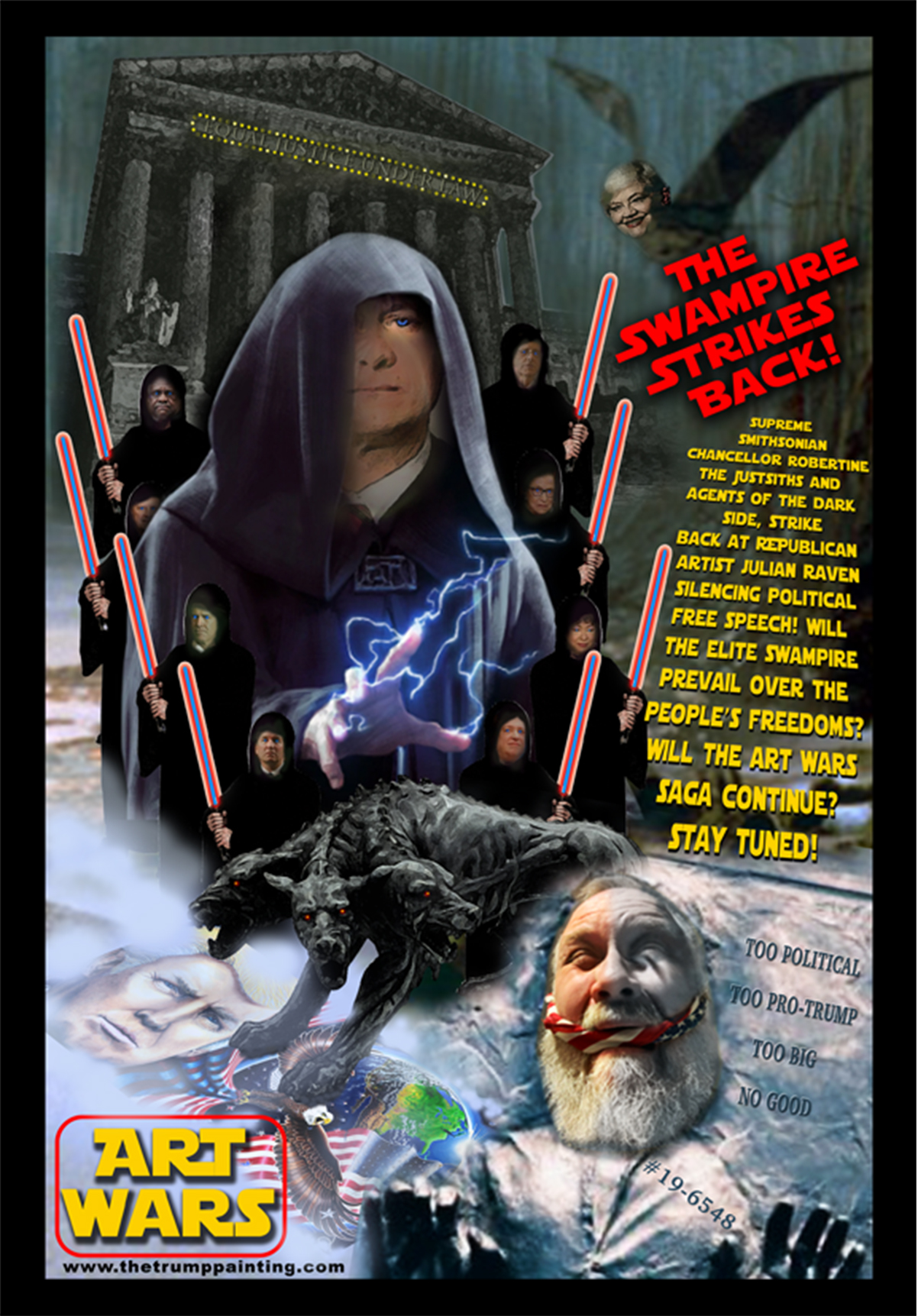
The Swampire Strikes Back - Gagged artist Julian Raven
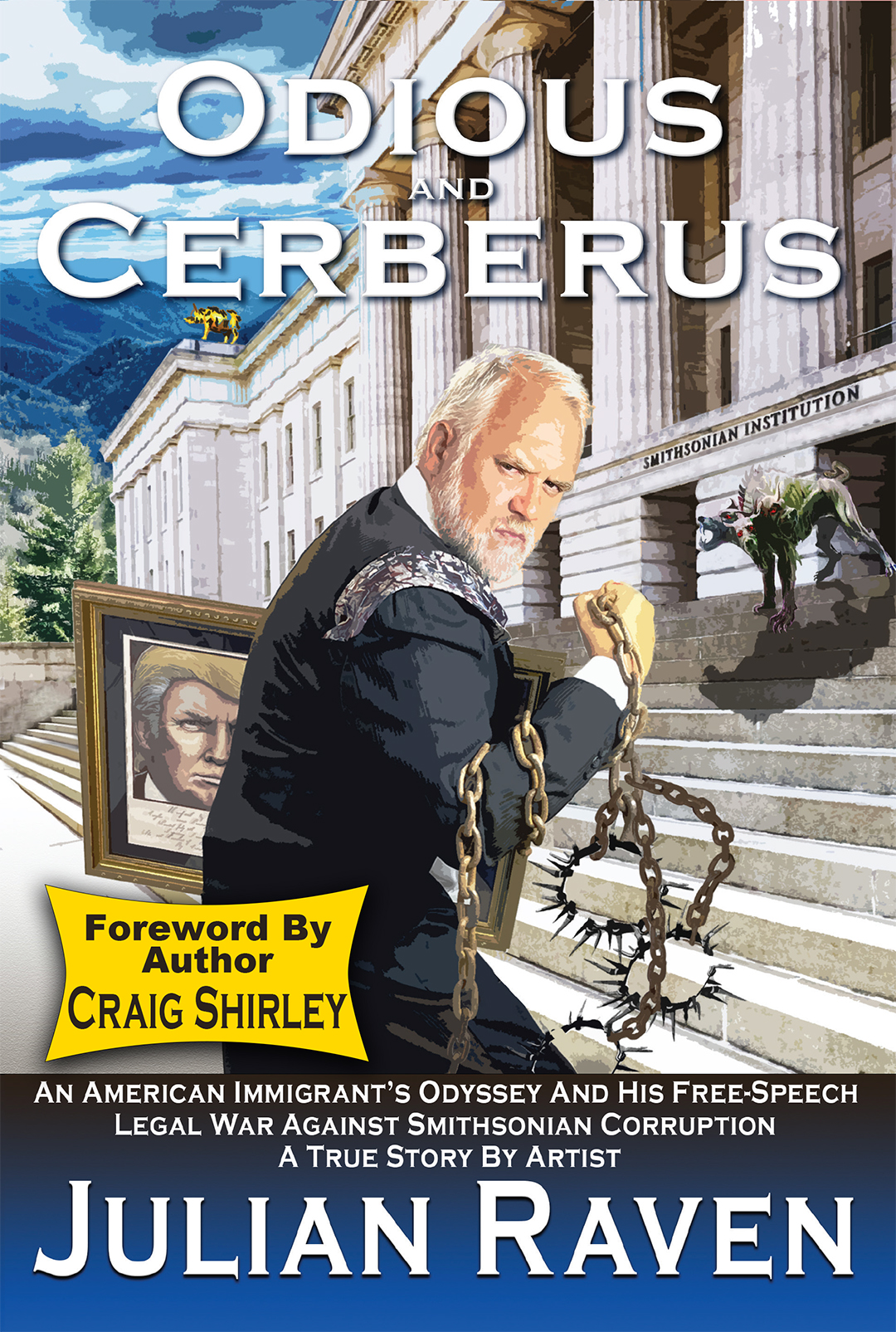
Front cover of new book by artist and former Trump supporter Julian Raven
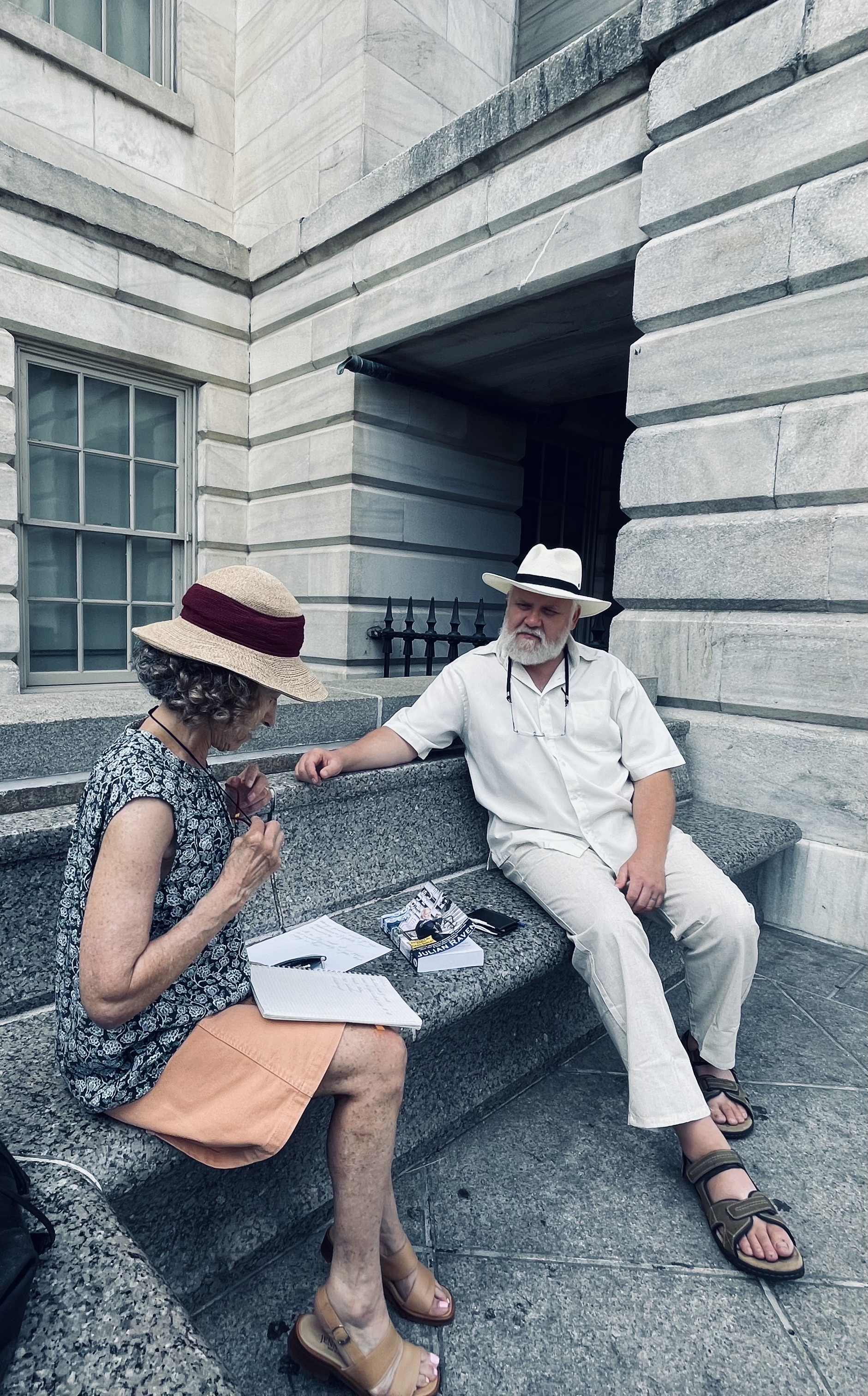
An interview at the Smithsonian National Portrait Gallery
Former British citizen's Free-Speech legal war against Australian Director Kim Sajet of the Smithsonian Portrait Gallery exposes SCOTUS' failure in New Book
You would think that after the U.S. Supreme Court ruled in 2017 that the ‘Government Speech Doctrine is susceptible to dangerous misuse,’ any Petition for Certiorari before the court claiming government-speech-doctrine abuse would have received immediate judicial review. It is inconceivable to the honest and reasonable mind that the elevated threat to 1st Amendment protected free-speech rights, defined by the Supreme Court as ‘dangerous,’ could ever escape meticulous scrutiny. It would be similar if a major hospital’s esteemed doctors warned the public of the severe dangers of leprosy and then refused to see a man in the emergency ward carrying a paper bag with his fingers and toes that had fallen off.
This is artist Julian Raven’s story at the U.S. Supreme Court. The dangerous misuse happened to Raven’s 1st Amendment free-speech and viewpoint discrimination lawsuit against the Smithsonian Institution (Chief Justice John Roberts, also being Smithsonian Chancellor) and the Director of the National Portrait Gallery, the Australian citizen Kim Sajet.
Courts in general, are extremely careful in their selection of words in their written decisions to avoid any inflammatory rhetoric keeping their words dispassionate and lawyerly. The word ‘dangerous’ is not a specific legal term; it is a common word used by the general population. There is no ambiguity with the word dangerous. Guns are dangerous. Motorcycles are dangerous. Poisonous snakes are dangerous. The misuse of the Government Speech Doctrine is dangerous. The court could have used softer adjectives to describe the problem, but no, they used a loaded word packed with an imminent warning.
Take a close look at SCOTUS’ danger warning: “But while the government-speech doctrine is important—indeed, essential—it is a doctrine that is susceptible to dangerous misuse. If private speech could be passed off as government speech by simply affixing a government seal of approval, government could silence or muffle the expression of disfavored viewpoints. For this reason, we must exercise great caution before extending our government-speech precedents.” Matal v. Tam, 137 S. Ct. 1744, 1758 (2017)
The U.S. Supreme Court immediately recognized the threat to the 1st Amendment’s free-speech right because, since its use, the government has become a speaker who also exercises competing 1st Amendment free-speech rights. As bizarre as that may sound, it is true and rightly the cause for alarm. Granted, as SCOTUS held, the doctrine is essential because the government’s function could be thwarted every time a citizen claimed a free-speech violation in a government-controlled forum specifically for government use. So the precise definition and use are critical to the unimpeded function of government.
The dangerous problem arises when the Government Speech Doctrine is used as a pretext for silencing speech, particularly disfavored viewpoints where the government has no speech rights. This is especially true in an undefined or ill-defined public speech forum, as in Raven’s unprecedented case against the Smithsonian Institution and the Knight v Trump Twitter free-speech case. Twitter was a newly created participatory social media platform where government officials began to promote their agendas and policies, creating a 1st Amendment free-speech forum. Knight v Trump, similar to my unprecedented case, immediately had the Department of Justice claiming government speech rights superseded the participation of citizen free-speech rights. The Knights prevailed against Trump, as all of the courts agreed Twitter was a participatory free-speech forum, not Raven’s case, though!
In Raven v Sajet, the District Court dismissal and memorandum opinion did not receive the Supreme Court’s 1st Amendment mandated deep-dive judicial review at the Court of Appeals for the District of Columbia Circuit. In Knight v Trump, the appellate court made a deep dive investigation into the free-speech appeal and concluded with a 29-page ruling in favor of the District’s court decision. In Raven's case, as a self-represented struggling artist and pro se litigant, a mere paragraph contradicted the U.S. Supreme Court’s decision in LeBron v Amtrak that stated that private entities with government-appointed boards are subject to the 1st Amendment. Remarkably the three-judge appellate panel held the opposite, ignoring the plainly ruled Supreme Court precedent. Compliance with the U.S. Supreme Court mandated that the whole docket be examined in 1st Amendment cases, which mine was, was ignored!
In Raven’s new book ‘Odious and Cerberus: An American Immigrant’s Odyssey and His Free-Speech Legal War Against Smithsonian Corruption’ he documents this story in detail. Former U.S. President and Chief Justice William Taft and Chief Justice Warren Burger declared, “The Smithsonian is not, and never has been considered a government bureau. It is a private institution under the guardianship of the government.” But, contradicting the esteemed jurists and Smithsonian chancellors, newly appointed District Court Judge Trevor McFadden ruled in 2018 that (District Court case number: 1:17-cv-01240 (TNM)) the Smithsonian Institution is the government “through and through.” He claimed, “the National Portrait Gallery has historically communicated messages from the government, in the sense that it compiles the artwork of third parties for display on government property.” But contradicting Judge McFadden, Peter G. Powers, former Smithsonian’s general counsel from another Smithsonian scandal, documented in Raven's book, said to congress at that time, “that virtually all Smithsonian properties, including the museums on the Mall in Washington, legally belong to the Institution and not to the federal government….”
McFadden’s dangerous Smithsonian property ownership error was the basis for his pretextual and specious misuse of the Government Speech Doctrine, ignoring the Supreme Court’s warning and gagging Julian Raven as a result. Raven’s unprecedented 1st Amendment free-speech case cried out for judicial
review from the Supreme Court to ‘say what the law is’ regarding the Smithsonian Institution as a free-speech forum; SCOTUS said ‘No!’
Julian Raven
The Raven Society
info@julianraven.com
Visit us on social media:
Facebook
Twitter
LinkedIn
Smithsonian Board of Regents Reform Initiative Exposing Corruption in New Book By Julian Raven
Legal Disclaimer:
EIN Presswire provides this news content "as is" without warranty of any kind. We do not accept any responsibility or liability for the accuracy, content, images, videos, licenses, completeness, legality, or reliability of the information contained in this article. If you have any complaints or copyright issues related to this article, kindly contact the author above.
