
Dr. Edward Corpus Reyes - How to become a cardiologist
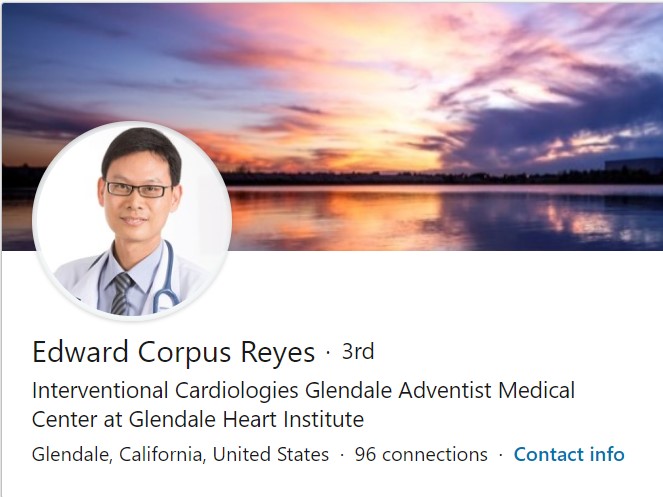
Doctor Edward Corpus Reyes
Dr. Edward Corpus Reyes Breaks down the years and the experiences needed on becoming a Cardiologist.
LOS ANGELES, UNITED STATES, May 14, 2020 /EINPresswire.com/ -- If you are reading this article on how to become a cardiologist, you are contemplating embarking on a long, challenging, and most importantly, fulfilling journey. The path to becoming a cardiologist, believe it or not, begins during undergrad because a career in medicine draws people who are very ambitious, driven, and competitive. This competition grows fiercer as the year's progress and therefore it is of utmost importance that you do as well as you can during each stage of your academic life because of it all counts.A Cardiologist’s Route Through Medical School Years: 4
Dr. Edward Corpus Reyes Experience on the 4 Years.
The first two years of medical school are composed of basic sciences such as classes in pathology, biochemistry, and pharmacology after which you will take your first of the medical licensing exams (USMLE Step 1). A rigorous eight-hour exam comprised of more than 300 multiple-choice questions. This exam will be a major determinant of your future career the score used as a benchmark for residency programs to offer or decline your interviews.
During your third year, you will make your transition into the hospital and will apply what you have learned during your first two years. You will rotate through each of the core rotations including Internal Medicine, Obstetrics and Gynecology, General Surgery, Pediatrics, and Psychiatry. After this is the second licensing exam (USMLE Step 2) taken in your final year of medical school. There is a knowledge aspect to USMLE Step 2, known as Step 2 CK, and a clinical skills aspect to Step 2, known as Step 2 CS. These are two different exams taken on two different days. Each of these exams is eight to nine hours.
Cardiology is a sub-specialty of Internal Medicine, so you need to do an internal medicine residency in order to become a cardiologist. You will apply to various Internal Medicine residency programs during your final year of medical school and will match at a residency where the next step of your training lies. During these four years, it would be wise to find time to do research as well, as this will help your chances of securing a strong Internal Medicine residency and therefore increase your chances of becoming a cardiologist.
Internal Medicine Residency
Number of years: 3
Cardiology is a medical specialty, as opposed to a surgical specialty, so you will be required to complete a three-year internal medicine residency on the road to becoming a cardiologist. During these three years, you will learn to become comfortable with evaluating and managing a wide array of medical conditions prior to specializing in the heart. It is important to match into an Internal Medicine program with the best standing and name as possible, as this will make it easier for you to match into a Cardiology fellowship. Another benefit of training at a well-known residency is that you will have better exposure to leaders in the field of Cardiology who may write your letters of recommendation. You will spend countless hours and weekends taking care of ill patients however you will need to show your genuine interest in becoming a cardiologist by getting involved in various research projects and if possible presenting at conferences or even publishing articles, as the field is very competitive. This will build your CV nicely to set you up for a Cardiology fellowship. You will apply during the beginning of your third year and find out where you have been accepted half way through the third year in residency.
Cardiology Fellowship Number of years: 3
Dr. Edward Corpus Reyes Fellowship Years.
Next is a general cardiology fellowship where you will continue your journey for another three years. The general cardiology fellowship is where you learn to manage a wide range of cardiac conditions from coronary artery disease to valvular heart disease to heart failure and others. You will delve into the depths of the field of cardiology and learn to perform procedures such as the heart catheterization and echocardiography.
Edward Corpus Reyes
ECR Medical Group
+1 9513657777
email us here
Visit us on social media:
LinkedIn
Legal Disclaimer:
EIN Presswire provides this news content "as is" without warranty of any kind. We do not accept any responsibility or liability for the accuracy, content, images, videos, licenses, completeness, legality, or reliability of the information contained in this article. If you have any complaints or copyright issues related to this article, kindly contact the author above.
