
Automatic Segmentation of Neural Tissue in 3D Electron Microscopy Images Using Deep Learning. The Launch of Aivia 6.
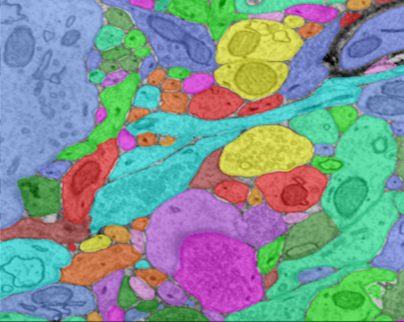
Automatic Segmentation of Serial EM Images
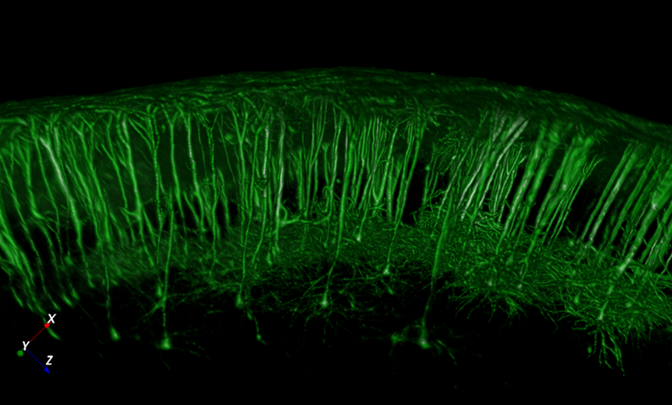
Fast Rendering of Large 3D Fluorescence Image. Image Credit: Daniel Bloodgood, Kash Lab (University of North Carolina)
Aivia 6 also features an innovative volume rendering engine capable of interactively displaying multi-terabyte 3D/4D microscopy images in real-time. The growing popularity of light sheet microscopes and tissue clearing techniques enable the scientific community to image large samples (on the scale of whole organs or even organisms) at high temporal and spatial resolution. As a result, researchers routinely generate 3D/4D images of 10s of gigabytes (GB) up to multi-terabytes (TB) which fail to render in nearly all microscopy image visualization tools currently available. With Aivia 6, a 37 GB 3D image is displayed in less than 3 seconds. While a 240 GB 4D image (2 GB per 3D time point) renders in 1.5 seconds.
“Machine and deep learning approaches are poised to revolutionize the way the microscopy community conducts image analysis. Examples from other communities and industries clearly show the benefits and the biomedical scientific community is starting to adopt machine learning aided image analysis. Aivia 6 introduces the first commercially available deep learning model for 3D electron microscopy image segmentation.” Commented Luciano Lucas, PhD (Executive VP at DRVISION). “We are also excited about the high-performance volume rendering engine we are launching today as it is capable of interactively rendering multi-terabyte 3D/4D images. For the first time, many of the researchers using light sheet microscopes will be able to visualize their 3D/4D data sets in real-time.”
More info: Aivia is a pioneering software for image visualization, morphometric analysis and phenotype classification/discovery. For visualization it can display images both on a regular computer screen and in virtual reality using the HTC Vive or the Oculus Rift headsets. Aivia’s analysis portfolio includes, in addition to the new deep learning model in Aivia 6, 15 analysis pipelines for 2 to 4D fluorescence microscopy images as well as 2D and 2D plus time phase contrast images. The most popular tools are 3D object analysis, 3D neuron and spine analysis, cell detection and tracking, colocalization, exocytosis and calcium oscillation analysis. Downstream of the analysis Aivia enables users to leverage the power of supervised machine learning to identify and discover novel phenotypes.
Aivia 6 trial license, webpage, release notes:
https://www.drvtechnologies.com/demo
https://www.drvtechnologies.com/aivia6
https://www.drvtechnologies.com/news
References:
(1) Jegou S., et al., arXiv:1611.09326v3 [cs.CV]
(2) Huang G., et al., arXiv:1608.06993v4 [cs.CV]
(3) Donahue J., et al., arXiv:1310.1531v1 [cs.CV]
Quyen Tran
DRVISION Technologies
1-855-423-5577
email us here
Aivia 6 - Convolutional neural networks for automated image segmentation of 3D electron microscopy
Legal Disclaimer:
EIN Presswire provides this news content "as is" without warranty of any kind. We do not accept any responsibility or liability for the accuracy, content, images, videos, licenses, completeness, legality, or reliability of the information contained in this article. If you have any complaints or copyright issues related to this article, kindly contact the author above.
