
China’s Manufacturing Industry to Return to Double-Digit Growth
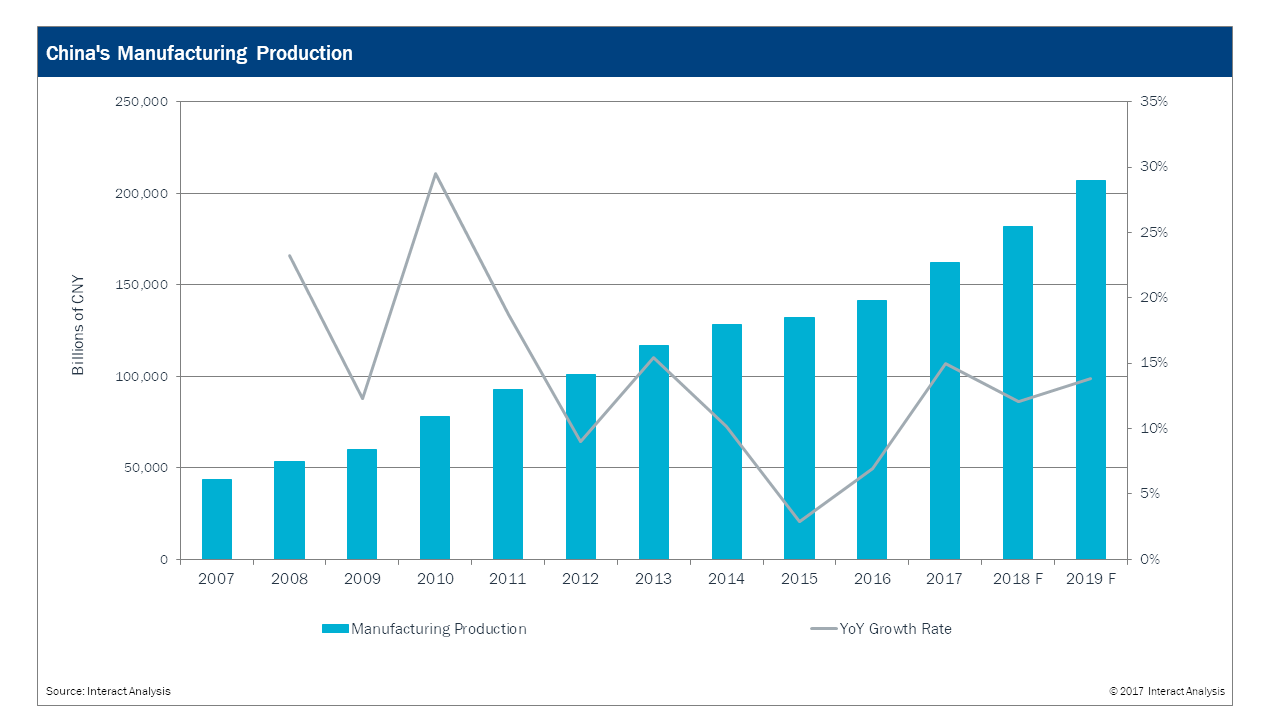
The manufacturing sector in China is forecast to exceed 200 trillion RMB (US$ 30 Trillion) in 2019 – more than double the value of the sector in 2012

Jan Zhang - Research Director
China’s manufacturing sector is predicted to return to a double-digit growth cycle for the next two years, according to a new report from Interact Analysis.
The manufacturing sector in China is forecast to exceed 200 trillion RMB (US$ 30 Trillion) in 2019 – more than double the value of the sector in 2012 when it surpassed the 100 trillion RMB threshold.
A Positive Outlook Following a Turbulent Few Years
Following years of capacity adjustment and supply-side reform, China’s manufacturing industry started to experience a pick-up in both production output and profits during the second half of 2016. This has clearly continued into 2017, and Interact Analysis predicts this current manufacturing growth cycle to continue in China in 2018 and 2019.
“The various data points we collected for end-user industries and machinery sectors show that China’s manufacturing industry performance was incredibly strong in the first three quarters of 2017, with industries such as commercial vehicle production, aggregates production, and electrical & electronics equipment contributing significantly to this growth” said Jan Zhang, Research Director at Interact Analysis. “Our forecast reflects our anticipation that the fourth quarter will continue in a similar fashion.” said Zhang.
Underlying Drivers of Robust Growth & China’s Advantage
Moving forward, the report revealed a positive outlook for Chinese manufacturing due to three fundamental components. “First, the macro-economic environment has improved, and manufacturers globally are enjoying a period of favorable growth. Next, the structural changes in industry are now reaping benefits for producers in the region, and heavy and high-polluting industries (such as mining, steel and chemicals) are recovering rapidly from a difficult period. Finally, the Chinese manufacturing industry has developed certain advantages that will help long-term competitiveness versus other regions around the world.” explained Zhang.
Advantage #1: An enormous growing domestic market
As the huge potential of the domestic market is increasingly being realized, it in turn is driving industry production and product upgrades. This growth in domestic consumption is stimulated by continued urbanization and the rise of the middle class in China, coupled with their demand for higher quality commodities and service. This provides two main advantages for local producers. Firstly, it enables Chinese manufacturers to increase the scale of standardized production of a single product to a level never before seen, therefore dramatically reducing the cost of a single product. Secondly, it provides a huge test bed for many products and applications, which can help Chinese manufacturers move ahead quickly in many fields.
Advantage #2: The ongoing expansion to overseas markets (i.e. “The Belt and Road Initiative”)
“The Belt and Road Initiative”, which is a government plan to invest in infrastructure to support global trade, provides further growth opportunities for Chinese manufacturers by expanding overseas - not only by exporting products - but also involving technology and strategic cooperation with foreign entities. Interact Analysis expects infrastructure and relevant equipment/machinery industries represent the first group that stand to benefit from this initiative, including electric power, railway, and ports.
Advantage #3: The building of complete industry value chains for many sectors
The complete industry value chain and enormous home market has made it possible for many component suppliers and system integrators in China to gradually transform into independent manufacturers, providing sophisticated products or systematic solutions. Typically, industries in other major economies tend to rely on the imports and exports of components and sub-systems to produce finished goods. China’s economic reforms, on the other hand, have created major manufacturers at almost every step of the value chain within major industries (e.g. electronics industry, high-speed trains and aviation).
Advantage #4: Efficiency
Industrial upgrades that happened in the past few years have significantly improved productivity and equipment utilization rates, especially for traditional industries. Alongside this, operational and management efficiency, optimization has been an ongoing effort especially for those companies which have grown into leading positions in their industries.
In summary, “made in China” is no longer a synonym for cheaply produced low-end products that are of inferior in quality. Rather, China’s manufacturers are quickly moving up the global manufacturing value chain and we believe China’s manufacturing sector will continue to grow robustly as a result.
Ash Sharma
Interact Analysis
+44 1933 654245
email us here
Legal Disclaimer:
EIN Presswire provides this news content "as is" without warranty of any kind. We do not accept any responsibility or liability for the accuracy, content, images, videos, licenses, completeness, legality, or reliability of the information contained in this article. If you have any complaints or copyright issues related to this article, kindly contact the author above.
