
FAO Food Price Index’s 6-Month Low Reflects Rebuilding for Some World Commodities
ROME -  (NewMediaWire) - August 7, 2014 - The UN Food and Agriculture
Organization (FAO) Food Price Index decreased
for a fourth consecutive month in July mainly due to a sharp decline in
international prices for maize, wheat and certain oilseeds, reflecting
ample supplies for these commodities.
(NewMediaWire) - August 7, 2014 - The UN Food and Agriculture
Organization (FAO) Food Price Index decreased
for a fourth consecutive month in July mainly due to a sharp decline in
international prices for maize, wheat and certain oilseeds, reflecting
ample supplies for these commodities.
"The lingering decline of food prices since March reflects much better expectations over supplies in the current and forthcoming seasons, especially for cereals and oils, a situation that is expected to facilitate rebuilding of world stocks," said FAO senior economist Concepción Calpe.
In contrast, meat prices rose for the fifth consecutive month in July, and those for sugar remained firm. The fall in quotations for grains, oilseeds, as well as dairy products pushed down the FAO Food Price Index to its lowest level since January 2014.
"Livestock product markets have their own dynamics: in the case of meat, beef in particular, many exporting countries are in a herd-rebuilding phase, which is limiting availability for exports and sustaining prices," Calpe said. "As for dairy products, supplies available for trade appear to be abundant, which, along with a faltering import demand, has weighted on July's quotations," she added.
Sharp slide in cereal and oilseed prices
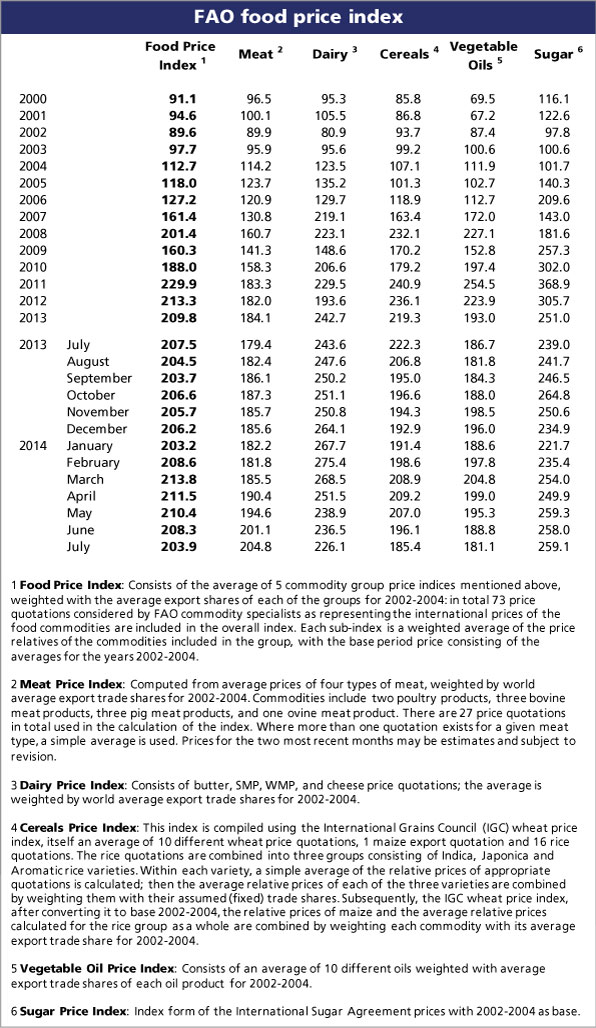
The FAO Cereal Price Index averaged 185.4 points in July, down 10.7 points or5.5 percent from June and as much as 36.9 points or 16.6 percent below the level one year ago.
In particular, the fall in international prices for maize (down 9.2 percent from June) and wheat (down 5.8 percent) reflected excellent production prospects as well as expected abundant exportable supplies in the 2014/15 marketing season.
In contrast, rice prices edged marginally higher, on renewed import demand, especially as Thailand's sales from public reserves remained suspended.
The FAO Vegetable Oil Price Index averaged 181.1 points in July, down 7.7 points or 4.1 percent from June. The decline continued to be primarily driven by falling soy and palm oil prices.
Soy oil values fell mainly in response to record crop prospects for the United States as well as abundant supply in South America while palm oil quotations eased on persisting strength in Malaysia's currency and slow global import demand. Prices for rape and sunflower seed oil also weakened, reflecting ample crop prospects for 2014/15.
The FAO Dairy Price Index averaged 226.1 points in July, down 10.3 points (4.4 percent) over June and 17.5 points (7.2 percent) less than the same period last year. Reduced import demand - including a decline in purchases of butter by Islamic countries during Ramadan - contributed to the downward trend in dairy prices.
Meat prices rise while sugar remains volatile
A continued strong demand for meat in Asia and particularly China, helped to edge up the FAO Meat Price Index which averaged 204.8 points in July, 3.7 points (1.8 percent) higher than its revised value in June and 25.4 points (14.1 percent) above the same period last year. Average prices for poultry and ovine meat also rose, while those for pig meat fell back somewhat from the all-time high registered in June.
The FAO Sugar Price Index averaged 259.1 points in July, marginally up by 1.1 points (0.4 percent) from June, and 20.2 points (8.4 percent) higher than in July 2013. International sugar prices have been relatively volatile over the last three months, amid uncertainty over the impact of a drought on sugarcane in Brazil, the world's largest producer and exporter and indications of below average monsoon rains in India, the second largest world sugar producer.
The FAO Food Price Index is a measure of the monthly change in international prices of a basket of food commodities. It consists of the average of five commodity group price indices, weighted with the average export shares of each of the groups for 2002-2004.
GRAPHICS/TABLE: http://www.fao.org/worldfoodsituation/foodpricesindex/en/
Monthly release dates for the remainder of 2014: 11 September, 09 October, 06 November, 04 December.
AUDIO:
Shirley Mustafa, Economist at FAO, on the latest update of the Food Price Index
LEARN MORE:
FOLLOW US:
https://www.facebook.com/UNFAO https://twitter.com/FAOnews/lists/fao-twitter-accounts
News on humanitarian response to disasters, emergencies and food security crises:
http://www.fao.org/news/rss-feed/en/
https://www.flickr.com/photos/faonews/collections/
http://www.slideshare.net/FAOoftheUN
FAO YouTube Channel: https://www.youtube.com/channel/UCM93UMoQKlj_8wTACRvl1iQ
ABOUT FAO
Achieving food security for all is at the heart of FAO's efforts – to make sure people have regular access to enough high-quality food to lead active, healthy lives. Our three main goals are: the eradication of hunger, food insecurity and malnutrition; the elimination of poverty and the driving forward of economic and social progress for all; and, the sustainable management and utilization of natural resources, including land, water, air, climate and genetic resources for the benefit of present and future generations.
FAO creates and shares critical information about food, agriculture and natural resources in the form of global public goods. But this is not a one-way flow. We play a connector role, through identifying and working with different partners with established expertise, and facilitating a dialogue between those who have the knowledge and those who need it. By turning knowledge into action, FAO links the field to national, regional and global initiatives in a mutually reinforcing cycle. By joining forces, we facilitate partnerships for food and nutrition security, agriculture and rural development between governments, development partners, civil society and the private sector.
An intergovernmental organization, FAO has 194 Member Nations, two associate members and one member organization, the European Union. Headquartered in Rome, Italy, FAO is present in over 130 countries. http://www.fao.org
CONTACT:
FAO Media Office (+39) 06 570 53625 FAO-Newsroom@fao.org
Peter Mayer Media Relations (Rome) (+39) 06 570 53304 peter.mayer@fao.org
Legal Disclaimer:
EIN Presswire provides this news content "as is" without warranty of any kind. We do not accept any responsibility or liability for the accuracy, content, images, videos, licenses, completeness, legality, or reliability of the information contained in this article. If you have any complaints or copyright issues related to this article, kindly contact the author above.
