
RUSSIA, December 21 - The meeting attendees focused on the federal service’s performance in 2023 and plans for the near future. The Rosgidromet Head informed the Prime Minister about new services for consumers, expanding the satellite constellation, implementing projects in the Arctic and Antarctic, and launcing a climate monitoring network in the new regions.
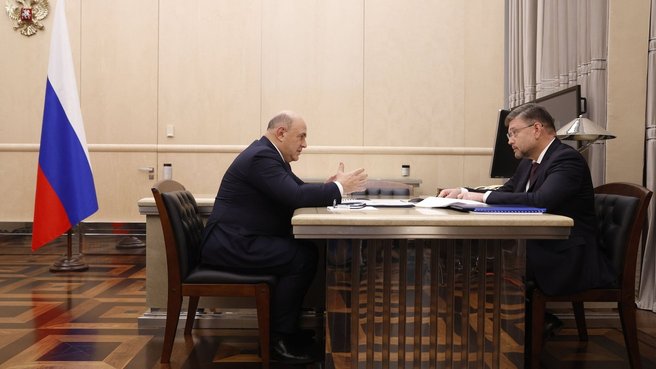
Mikhail Mishustin meets with Head of the Federal Service for Hydrometeorology and Environmental Monitoring Igor Shumakov
20 December 2023
Mikhail Mishustin at a meeting with Head of the Federal Service for Hydrometeorology and Environmental Monitoring Igor Shumakov
20 December 2023
Mikhail Mishustin meets with Head of the Federal Service for Hydrometeorology and Environmental Monitoring Igor Shumakov
Excerpts from the transcript:
Mikhail Mishustin: Good afternoon, Mr Shumakov.
Rosgidromet plays a very important role in collecting and analysing environment- and weather-related data. Of course, this significantly influences all sectors of our economy, including transport, agriculture, energy, construction and many others.
You are the first to identify and warn the country of high-risk natural phenomena and climate change. You use domestic satellites for this, as well. You help plan air traffic, and several other very significant functions. Please tell us how your work is organised.
Igor Shumakov: Mr Mishustin, Rosgidromet today has over 30,000 employees and more than 12,000 environmental observation stations. As you said, there are 14 domestic satellites in orbit that we use for hydrometeorological purposes. We also use research vessels and super-computer technologies. Despite the sanctions, we still remain among the top five forecasting services in the world.
We showed good performance in 2022. We carried out all the planned activities, with a tangible economic effect on the country’s economy in the amount of 66.2 billion roubles. This is almost 4 billion roubles more than in 2021.
We managed to increase the accuracy of our short-term forecasts and storm advisories up to 96.7 percent and to 96 percent, respectively.
At the same time, we constantly see an increase in hazardous natural phenomena that cause damage to the economy and the citizens of the Russian Federation. In the 1990-2000s, there were 200–250 such events every year, while now we record 300–400 per year. Over the first 11 months of this year, 425 high-risk events have been recorded. We are also succeeding in warning people about such weather activity in advance. For example, the latest events in the Far East, Typhoon Hanun in the Primorye Territory, when 600 mm of precipitation fell, or, to put it simply, 60 buckets of water per square metre. We responded promptly and gave an advisory five days in advance. Thanks to this, our colleagues from the Emergencies Ministry and the Primorye Territory managed to minimise the consequences of this emergency.
This year, we started offering a new service for consumers. We tested it for the first time with the spring flood forecast. Previously, we gave forecasts for regions, territories, and river basins, but now they are based on geography: cities, towns and villages. This service is receiving positive feedback, so we will continue to use it.
The satellite constellation is a very important data source in our work. And this year is truly a landmark year for the Russian hydrometeorological service: our colleagues from Roscosmos launched four meteorological satellites: Elektro, Meteor, Condor and Arktika-M No 2, which we are proud of.
Mikhail Mishustin: I have just read about the plans of Roscosmos and our other colleagues. They include remote sensing…
Igor Shumakov: This has not happened for several decades. In addition to the already launched satellites, we also produce radar units that can actually see through clouds. For users in the Arctic zone, along the Northern Sea Route, this is very important for forecasts. So, we will provide them with all-weather data. All this will certainly promote the development of our country’s economic potential.
After fully implementing the activities under the Federal Space Programme, we will soon become almost independent of foreign providers of this information. This is our common goal together with Roscosmos.
More to be posted soon…
